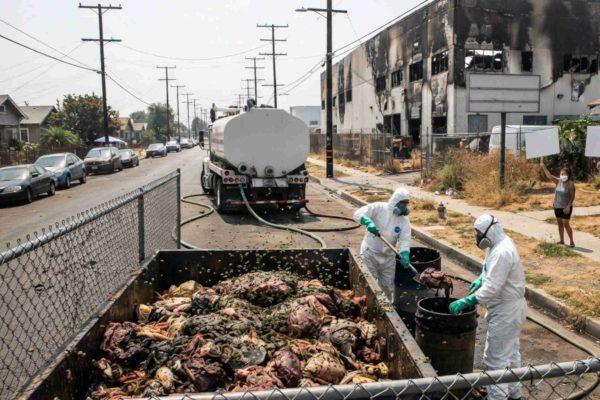
For weeks, the streets of Boyle Heights have been gripped by an unbearable stench. What began as a warehouse fire in mid-June has spiraled into a full-blown environmental crisis, as more than 80 million pounds of beef, poultry, and seafood left to rot under the Los Angeles sun have turned the neighborhood into a living nightmare.
Residents describe the odor as so overpowering that stepping outside feels like a punishment. The air is thick with decay, and even the early morning hours offer no relief. Local businesses, many of them family-owned taquerías and mercados that anchor this predominantly Latino community, are watching their customers disappear. The smell has driven away regulars, and the usual bustle of Boyle Heights has been replaced by a ghost-town quiet.
A Health Hazard Beyond the Smell
The crisis is not just olfactory. Health officials have confirmed that the massive decomposition has attracted green bottle flies, insects capable of transmitting serious infections. This has escalated concerns from a nuisance to a public health threat, especially for children, the elderly, and those with respiratory conditions.
Community members have organized, demanding urgent action from city officials. The mayor of Los Angeles has promised transparency, while the company responsible for the warehouse has accelerated its cleanup efforts, aiming to meet a deadline that can't come soon enough for residents.
“We can't live like this,” said María González, a lifelong Boyle Heights resident. “Our kids can't play outside. We can't open our windows. It's like we're being punished for something we didn't do.”
Millions Spent to End the Nightmare
In response, the company has deployed a multi-million dollar emergency operation. Crews are working around the clock to remove the decomposed remains, setting up rodent barriers and distributing hundreds of traps to curb the fly population. They claim the sanitation process is nearing its final stretch, but neighbors remain skeptical, vowing to stay vigilant until the air is breathable again.
This incident has also put a spotlight on broader issues of environmental justice in Los Angeles. Boyle Heights, a historically Mexican-American neighborhood, has long borne the brunt of industrial pollution and neglect. The city's crackdown on littering seems almost ironic when a single corporate disaster can create such devastation.
As the cleanup continues, the community's resilience is being tested. But Boyle Heights has a long history of organizing and fighting for its rights. From the fight against gentrification to the push for cleaner air, this neighborhood knows how to raise its voice. The question now is whether the city and the company will listen before the health crisis deepens.
For now, residents are left to cope with the stench, the flies, and the uncertainty. They are also looking ahead, demanding accountability and long-term solutions to prevent such a disaster from ever happening again. The nightmare may be ending, but the scars will linger.