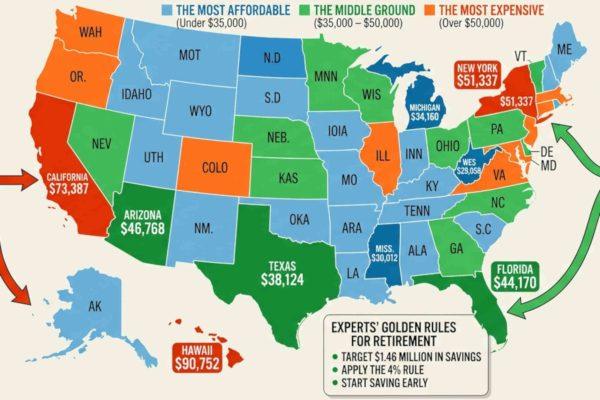
For many Latinos who have built their lives and careers in the United States, retirement is the reward for decades of hard work. But the financial reality of retiring in 2026 is shifting fast. A new analysis from MoneyLion reveals that the gap between the most and least expensive states to retire has widened to over $120,000 a year. That means where you choose to settle down can make or break your retirement plan.
Hawaii stands as the most expensive state for retirees, requiring an annual income of $156,610 to maintain a comfortable lifestyle—even after factoring in Social Security. On the opposite end, West Virginia offers the lowest cost of living in the nation, with a retiree needing just $29,059 per year to cover basic needs. For our Latino community, many of whom are concentrated in high-cost states like California, New York, and Florida, understanding these differences is crucial.
The Tax Factor: Why Some States Are Retiree Magnets
State taxes play a massive role in how far your savings go. California and New York not only have high consumer prices but also impose heavy taxes on income and real estate. That’s why many older Latinos are looking to states like Florida, Texas, and Tennessee, which do not tax individual income. This fiscal advantage can translate into thousands of dollars in annual savings, allowing retirees to stretch their ahorros much further.
For example, a retiree in New York needs about $51,337 annually for basic necessities, while in Texas that figure drops to $38,124. Over a 20-year retirement, that difference adds up to over $260,000. For families who have worked hard to build a nest egg, that kind of gap is impossible to ignore.
How Much Do You Really Need to Save?
Experts recommend aiming for a savings goal close to $1.46 million. This figure, according to financial planners, allows a person to generate enough monthly income to cover living expenses without depleting the principal for at least 30 years. To get there, many advisors suggest following the “4% rule” or the “25x rule,” which help calculate how much to set aside each month starting early in your career.
But for many Latinos, the challenge is compounded by the fact that we often support extended family—whether it’s helping mamá back home or contributing to a sibling’s education. That’s why it’s essential to start saving as soon as possible, even if it’s a small amount. As the cost of living continues to rise across the country, every dollar saved early can compound into significant security later.
Retirement Budget by State: A Quick Guide
Most affordable (under $35,000 annually):
- West Virginia: $29,059
- Mississippi: $30,012
- Louisiana: $31,232
- Arkansas: $31,352
- Oklahoma: $32,090
- Kentucky: $32,559
- Alabama: $32,898
- Michigan: $34,160
Middle ground and popular destinations ($35,000 – $50,000):
- Texas: $38,124
- Tennessee: $38,314
- Florida: $44,170
- Arizona: $46,768
- Maryland: $49,007
Most expensive (over $50,000):
- New York: $51,337
- New Jersey: $57,702
- Washington: $59,997
- Massachusetts: $68,020
- California: $73,387
- Hawaii: $90,752
These numbers are for basic necessities only. For a comfortable retirement that includes travel, dining out, and hobbies, the costs can be significantly higher. That’s why many Latinos are also considering relocating to more affordable regions, such as Nevada, which is becoming a top destination for Californians seeking cheaper housing. Read more about why Nevada is attracting so many families from the West Coast.
Another factor to consider is the rising cost of utilities. Summer electricity bills are expected to spike 8.5% in 2026, hitting Southern states hardest. For retirees on fixed incomes, this can be a significant budget line item.
Ultimately, the key to a secure retirement is planning early and understanding the financial landscape of your chosen state. For Latinos, who often prioritize family and community, the decision of where to retire is not just about money—it’s about finding a place where you can live well, stay connected, and enjoy the fruits of your labor. As the saying goes, más vale prevenir que lamentar.