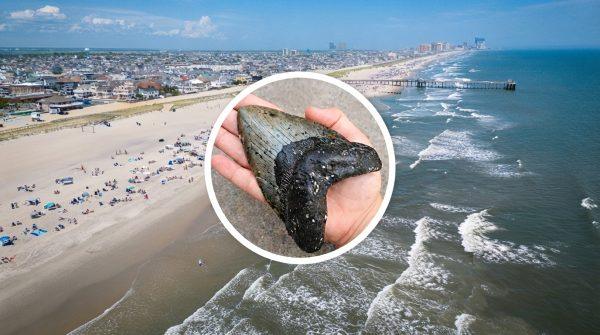
On an overcast day along the Jersey Shore, a father and son turned a simple beach walk into a prehistoric discovery. Mike Bowers and his 11-year-old son Bo were exploring the shoreline at Sea Isle City when Bo spotted something unusual wedged between the rocks. It turned out to be a 10-centimeter tooth from a megalodon, the giant shark that ruled the oceans millions of years ago.
The Bowers family, from Pennsylvania, had altered their original vacation plans because of the cloudy skies, opting for a coastal stroll instead. That decision led to a find that most fossil hunters only dream of. According to regional media reports, Bo slid his hand into a small rocky crevice out of pure curiosity and pulled out the ancient relic.
A rare fossil for the Garden State
Experts at the New Jersey State Museum have confirmed the authenticity of the tooth. Dana Ehret, a paleontologist at the museum, noted that this is only the sixth documented megalodon specimen found in the state. What makes it even more remarkable is its state of preservation, which Ehret described as extraordinary compared to typical finds along neighboring coastal areas.
Megalodon, or Otodus megalodon, was one of the largest predators in Earth's history, reaching lengths of over 20 meters. The species went extinct about 3.6 million years ago, leaving behind only fossilized teeth and vertebrae as evidence of its dominance. Finding such a well-preserved tooth on a dynamic shoreline like New Jersey's requires a rare combination of sedimentary conditions and sheer luck.
Keeping the treasure
Because the tooth was discovered on public land, local authorities have allowed the Bowers family to keep it. For the young Bo, this means a tangible piece of deep history to take home—a story he'll likely tell for years. The family's find has also sparked excitement among beachgoers and fossil enthusiasts, who are now flocking to Atlantic shores hoping to replicate the feat.
Marine biologists and paleontologists encourage anyone who makes a similar discovery to report it to academic institutions. Such reports help enrich historical records and protect the nation's paleontological heritage. They also remind us that the coast is not just a place for recreation but a living archive of Earth's ancient past.
This isn't the first time the Jersey Shore has made headlines for unexpected reasons. From environmental concerns to cultural milestones, the state continues to capture attention. But for the Bowers family, this moment is purely personal—a once-in-a-lifetime discovery that turned an ordinary vacation into an unforgettable adventure.
As tourism analysts point out, such fortuitous events can inspire a new generation of students to take an interest in marine archaeology and paleontology. What starts as a casual beach outing can become an educational expedition, proving that curiosity and a keen eye are sometimes all you need to uncover a piece of history.
For now, the megalodon tooth sits with the Bowers family, a reminder that the Atlantic coast guards secrets millions of years old, waiting for the right moment—and the right person—to reveal them.