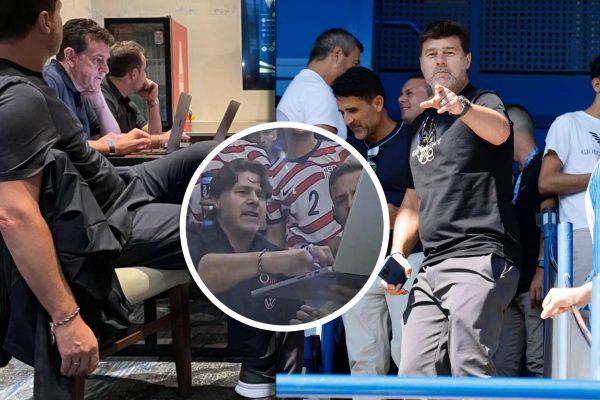
FIFA has officially confirmed that United States men's national team coach Mauricio Pochettino's use of a laptop during water breaks is fully within the rules. The decision, reported by The Athletic, ends weeks of speculation after the Argentine manager was spotted reviewing live video clips with his squad during a friendly against Senegal in March.
During that match, just 22 minutes in, Pochettino gathered his players around a compact laptop on the sideline during a three-minute cooling break. The U.S. went on to win 3-2 against the 14th-ranked African side, and the image of the huddle quickly went viral. Now, with FIFA's green light, that moment is no longer a curiosity—it's a blueprint.
What IFAB Rules Actually Say
The International Football Association Board (IFAB) has long permitted the use of electronic equipment on the sideline, as long as the devices are mobile and portable—essentially, laptop-sized. The only restriction for the 2026 World Cup is that active players cannot step off the pitch into the bench area during water breaks. They must gather at the edge of the touchline to view the digital displays.
Pochettino, who previously managed Tottenham Hotspur and Paris Saint-Germain, has been a vocal advocate for integrating technology into in-game coaching. He argues that visual reinforcement is far more effective than shouting instructions from the technical area, especially for a generation of players accustomed to instant video feedback.
“It’s not about showing off,” Pochettino said in a press conference after the Senegal match. “It’s about giving the players the clearest possible information in the shortest time. Three minutes is not a lot, but with a screen, you can show them exactly what you mean.”
How This Changes the 2026 World Cup
The 2026 World Cup, co-hosted by the United States, Mexico, and Canada, will feature an expanded 48-team field and mandatory water breaks designed to combat extreme heat. Those breaks will also double as three-minute commercial windows, effectively splitting matches into four quarters. Teams that can use that time efficiently—like Pochettino's USMNT—will have a strategic edge.
For Latino fans, this is particularly relevant. The tournament will be played across three nations, with Mexico City's Estadio Azteca hosting matches at high altitude and in potentially sweltering conditions. Teams like México, Argentina, Brasil, and Uruguay will need to adapt their sideline strategies. The ruling also opens the door for other coaches—like Lionel Scaloni of Argentina or Tite's successor in Brazil—to adopt similar tech-heavy approaches.
This isn't just about laptops. It's about how the game is managed in real time. For decades, Latin American football has relied on the passion and intuition of coaches like Carlos Bilardo or Marcelo Bielsa. Now, the next generation of managers will have to balance that instinct with data-driven adjustments, all within the span of a water break.
As the 2026 World Cup approaches, expect more teams to experiment with sideline technology. The USMNT's early adoption under Pochettino may give them a head start, but rivals across the Americas will be watching closely. For fans in Bogotá, Buenos Aires, Lima, and Ciudad de México, this is a reminder that football is evolving—and that the margins between victory and defeat are getting thinner.
For more on how the tournament is shaping up, check out our guide to World Cup 2026 stadium rules and the latest on VAR changes that could affect your team.