Every autumn, as the air turns crisp and storefronts fill with orange and purple, two distinct celebrations take shape across the Americas. On one side, Halloween—with its carved pumpkins, spooky decorations, and mountains of candy—has become a global phenomenon. On the other, Día de Muertos, a deeply spiritual tradition rooted in Mexico, invites families to remember and welcome their departed loved ones with color, flavor, and reverence.
Though they share the calendar, these two observances could not be more different in origin and meaning. Understanding that difference is key to appreciating the richness of Latino culture and the ways we honor those who came before us.
Ancient Roots: From Mictlán to Samhain
Día de Muertos traces its lineage to the pre-Hispanic civilizations of Mexico—the Mexicas, Mixtecs, and Zapotecs—who conceived death not as an ending but as a journey to Mictlán, the underworld. For them, the dead continued to exist, and the living had a sacred duty to guide them through the afterlife with offerings. This worldview gave rise to the tradition of building altars, or ofrendas, laden with photographs, favorite foods, marigold petals, and personal mementos that help souls find their way back home for one night each year.
Halloween, by contrast, has its origins in the Celtic festival of Samhain, celebrated over three thousand years ago in what is now Ireland, the UK, and northern France. Samhain marked the end of the harvest and the beginning of winter, a liminal time when the veil between the living and the dead was believed to thin. Villagers lit bonfires and wore masks—not to honor the dead, but to confuse and ward off malevolent spirits. That ancient practice eventually merged with Christian observances like All Hallows’ Eve, and Irish immigrants carried it to the United States in the 19th century, where it morphed into the secular, commercial celebration we know today.
Altars vs. Costumes: The Heart of Each Tradition
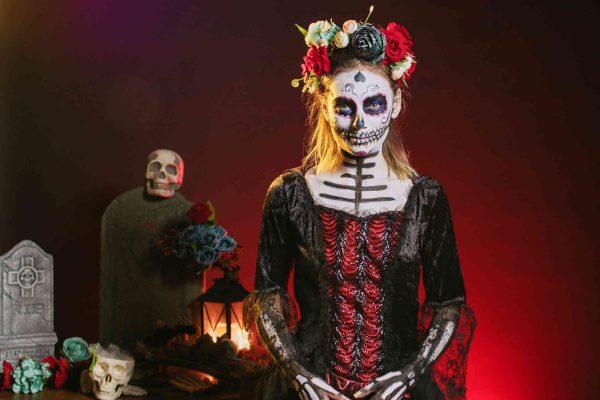
The most visible difference lies in the rituals themselves. In Mexico and across the Latino diaspora, Día de Muertos is a family affair. Homes and cemeteries are transformed into sacred spaces where the living and the dead reunite. Altars are built with care, each element carrying meaning: the cempasúchil (marigold) guides spirits with its vibrant color and scent; candles light the way; and the favorite dishes of the departed are placed as offerings to nourish them after their long journey. It’s a celebration of memory, love, and continuity—a way of saying, “You are not forgotten.”
Halloween, on the other hand, is about play and fright. The bonfires of Samhain evolved into jack-o’-lanterns, and the masks meant to confuse spirits became costumes—from ghosts and witches to superheroes and pop culture icons. Trick-or-treating, a 20th-century American invention, turns the night into a community-wide game of candy collection. The focus is on fun, not remembrance.
As the years pass, the lines between the two have blurred in some places. In the United States, Latino families often blend both: children may dress up for Halloween on October 31, then help build an altar for Día de Muertos on November 1 and 2. This cultural exchange is a testament to the resilience of tradition—it adapts without losing its core.
For those looking to understand the deeper meaning of the ofrenda, these surprising details reveal just how much thought goes into every element. And for families navigating the season, Halloween candy safety is a practical concern that doesn’t diminish the joy of the holiday.
Coexistence and Cultural Pride
Today, Día de Muertos has gained international recognition, thanks in part to films like Coco and the efforts of Latino communities abroad. In cities like Los Angeles, San Antonio, and Chicago, monumental altars are erected in public spaces, and festivals draw crowds of all backgrounds. Meanwhile, Halloween continues to grow in popularity in Mexico, especially among younger generations who enjoy the costume parties and spooky decor.
But for many, the two are not in competition. As one Mexican artist put it, “Halloween is a party; Día de Muertos is a reunion.” That distinction is crucial. While Halloween invites us to explore the mystery of death through entertainment, Día de Muertos invites us to embrace it with love and remembrance.
For those interested in how Latino families keep this tradition alive, this look at modern practices shows the enduring power of memory. And for a lighter take on the season, queer horror films offer a cozy way to celebrate the spooky side of autumn.
Ultimately, both traditions enrich our cultural landscape. They remind us that death is a universal experience, but how we honor it is deeply personal and profoundly cultural. Whether you’re building an altar or carving a pumpkin, you’re participating in a story that spans centuries and continents—a story that, in the Latino community, is told with color, flavor, and heart.