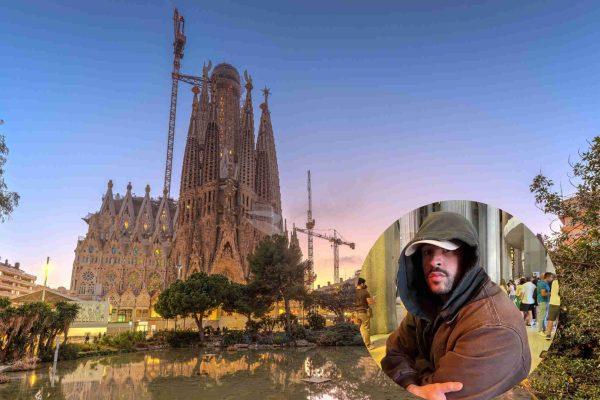
When Bad Bunny stepped into Barcelona's Sagrada Familia last week, he wasn't just entering one of Europe's most iconic basilicas—he walked straight into a cultural firestorm. The Puerto Rican superstar, in town for his tour, visited Antoni Gaudí's masterpiece alongside Salvador Illa, president of Catalonia's Generalitat. But it wasn't the political company that turned heads. It was what Benito wore: shorts that barely reached mid-thigh, a hoodie, and Yeezy sandals.
The Sagrada Familia's dress code is explicit: no shorts or skirts that leave more than half the thigh exposed, no hats or hoods inside. These aren't suggestions—they're enforced at the door for every tourist. Yet images of Bad Bunny strolling through the basilica's nave, hood up, legs bare, raced across social media, prompting a simple question: would any other visitor have gotten away with this?
A Question of Access and Respect
The debate isn't really about fabric length. It's about who gets to break the rules. Many pointed out that the same guards who stop a family from Rio or a couple from México City at the entrance apparently made no move to intercept the world's biggest Latin music artist. The presence of Illa's security detail and the political communication team only reinforced the perception of preferential treatment.
“If I showed up in shorts, they'd turn me away before I could say 'Gaudí,'” one user wrote on X. The sentiment echoed across platforms, with some defending the artist's right to comfort and others arguing that sacred spaces demand a baseline of decorum, regardless of fame. The incident has reopened a broader conversation about how religious sites balance accessibility with reverence—and whether celebrity status should ever override community standards.
Bad Bunny's team has not commented on the controversy, but the singer's choice of attire may have been an attempt at discretion. In a city where his every move draws crowds, a hoodie and sandals might have seemed like a low-profile option. It didn't work. The irony is that his effort to go unnoticed made him more visible than ever.
This isn't the first time Bad Bunny has blurred lines between personal style and institutional expectations. From his wax figure at Madrid's Museo de Cera to his Zara collection celebrating Puerto Rican craftsmanship, Benito has always operated on his own terms. But the Sagrada Familia moment touches something deeper: the tension between individual expression and collective respect in spaces that hold spiritual meaning for millions.
For many Latinos, the debate hits close to home. Whether in a cathedral in Bogotá, a church in San Juan, or a basilica in Barcelona, the question of how to dress in sacred spaces is often tied to identity, class, and migration. Rules that seem arbitrary to outsiders can feel like gatekeeping to those who've been told their way of dressing doesn't belong. Yet the Sagrada Familia's code applies to everyone—or at least, it's supposed to.
The incident also highlights the unique position of global Latin artists. Bad Bunny moves between worlds: the streets of Puerto Rico, the stages of Coachella, the halls of European power. His style is a deliberate statement, a refusal to code-switch for anyone. But when that style collides with a sacred site's protocols, it forces a reckoning with what respect looks like across cultures.
As the tour continues and the controversy fades, one thing remains clear: the Sagrada Familia visit has become a mirror reflecting our own assumptions about fame, faith, and fairness. Whether you side with the rulebook or the rebel, the conversation is far from over.