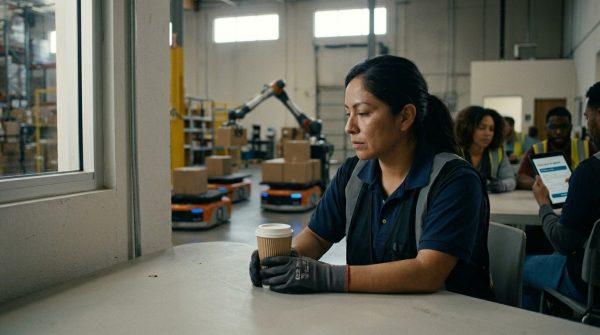
Artificial intelligence and automation are reshaping the U.S. labor market at a pace that few could have predicted just a few years ago. But for Latino workers, the threat is especially acute. According to a recent UCLA study, nearly one in three Latino employees—roughly 8.4 million people—work in occupations that are highly susceptible to being replaced by AI. That's a higher share than any other demographic group in the country.
These aren't just numbers on a spreadsheet. Behind each statistic is a family in Los Angeles, Houston, Miami, or Chicago whose primary breadwinner may soon find their job automated away. Economic reports from major financial institutions indicate that autonomous systems are already eliminating about 11,000 net jobs every month. And when workers are displaced, they often face long stretches of unemployment and, if they do find new work, it's frequently at lower pay.
Why Latino workers are in the crosshairs
The vulnerability isn't random. It stems from a long history of labor migration, language barriers, and limited access to higher education that has concentrated many Latinos in fields like agriculture, construction, manufacturing, retail, and food services. These are exactly the sectors where automation—from physical robots to advanced language models—is advancing fastest.
Tasks that once required manual dexterity or basic human oversight are now being handled by machines that never tire, never call in sick, and never ask for a raise. In California, for instance, Latino workers make up more than half of the 4.5 million jobs classified as high-risk. That kind of regional concentration means that if retraining programs don't scale quickly, entire communities could face economic instability.
Policymakers are starting to take notice. They emphasize that local economies dependent on manual labor must diversify their employment base to protect vulnerable groups from long-term financial setbacks. But for now, the burden often falls on individual workers to adapt.
Sectors facing the most disruption
- Warehousing and logistics: Major distribution companies are rapidly deploying robots in fulfillment centers, where Latino workers hold a significant share of jobs.
- Customer support: Conversational AI tools are threatening more than 2 million positions in call centers and customer service nationwide.
- Administrative services: Data entry, billing, and general office support roles are being automated at a fast clip, hitting entry-level workers especially hard.
Corporate leaders are prioritizing software efficiency over traditional staffing models, and restructuring efforts disproportionately affect those without advanced technical qualifications. It's a tough reality, but not one without solutions.
How Latino workers can adapt
Workforce advisors urge immediate action. The first step is to audit your daily tasks and figure out how much of your job involves repetitive digital work that could be automated. From there, free or low-cost training programs are available through platforms like Coursera, edX, and even some community colleges. Regional government agencies also offer dedicated retraining funds to help workers pivot into tech-adjacent fields.
Ultimately, the best defense against automation is continuous skill development. That might mean learning to use data analytics tools, picking up basic coding, or getting certified in project management. It's not about becoming a software engineer overnight—it's about staying flexible and informed.
For those feeling the squeeze, remember that this isn't just a personal challenge. It's a community-wide shift that calls for collective action. As Miami-Dade's rising cost of living pushes essential workers out, the need for accessible retraining and economic diversification becomes even more urgent. And while the road ahead may be uncertain, Latino workers have always found ways to adapt, innovate, and thrive.