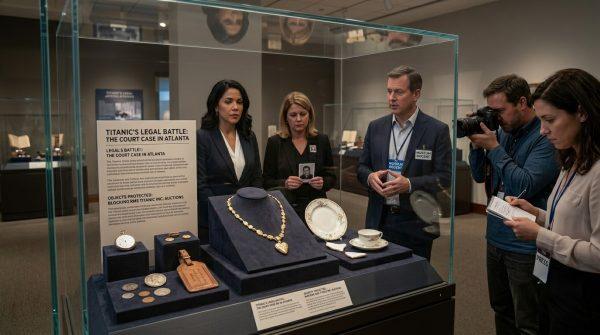
The United States government has stepped in to block the auction of artifacts from the RMS Titanic, launching a legal battle that could reshape how historic shipwrecks are treated under international law. The case, filed in June 2026 by the National Oceanic and Atmospheric Administration (NOAA), targets RMS Titanic Inc., a Georgia-based company that has recovered over 5,000 objects from the wreck since 1987.
At the heart of the dispute is a 1990s agreement that required the company to keep the entire collection unified. Now, RMS Titanic Inc. plans to sell more than 100 pieces on the secondary market and organize a four-city world exhibition tour. NOAA argues this violates the original covenant, which was meant to preserve the artifacts as a single, protected heritage site.
A Fragile Legacy Under the Atlantic
The Titanic rests nearly 4,000 meters deep in the North Atlantic, a site protected by a treaty between the United States and the United Kingdom. The wreck is considered an international sanctuary, honoring the more than 1,500 people who died in 1912. For many, including victims' families and heritage groups, the artifacts are not mere collectibles but sacred remnants of a human tragedy.
“These objects carry the stories of ordinary people—passengers and crew—whose lives were cut short,” says a spokesperson for a heritage advocacy group involved in the case. “Allowing them to be sold off piece by piece would be a disservice to history.”
The company’s attorneys, however, argue before a federal tribunal that the auction does not violate existing orders. They claim the sale is a legitimate way to recoup costs and fund future expeditions. The legal wrangling has drawn attention from maritime law experts, who see this as a test case for how nations balance preservation with commercial interests.
International Jurisdiction Adds Complexity
The case also involves France, as some of the first artifacts recovered were taken to European soil, where French authorities granted RMS Titanic Inc. legal ownership. The company argues that an American court lacks jurisdiction over those pieces, citing international maritime laws that conflict with US federal regulations. This transatlantic dimension could set a dangerous precedent if the court allows the company to bypass the original covenants based on decisions made decades ago in France.
“If the court rules in favor of the company, it could weaken multilateral agreements and open a legal vacuum where commercial interests prevail over historical preservation,” warns a legal analyst familiar with the case. “That would leave submerged treasures at the mercy of profit, forcing superpowers to redefine their laws to protect the most emblematic wrecks.”
The artifacts in question include personal belongings of passengers—such as clothing, letters, and jewelry—that offer a glimpse into daily life aboard the ship before the tragedy. Among the most striking pieces are a gold nugget necklace, a heart-shaped pendant, ancient coins, kitchen utensils, and decorative elements like a bronze cherub from the ship’s grand staircase. Each item tells a story, and their potential dispersal has galvanized opposition.
What’s at Stake for Latino Audiences
While the Titanic’s story is global, its legacy resonates deeply in Latin America, where the disaster claimed lives from countries like México, Argentina, and Chile. The ship carried immigrants and wealthy travelers from across the Americas, and the wreck’s preservation is a matter of shared heritage. For bicultural Latinos, this case underscores the tension between honoring history and allowing market forces to dictate its fate.
The federal court’s decision will mark a momentous milestone in modern maritime jurisprudence. It will determine whether preservation covenants prevail over corporate profit, and whether commercial entities can dismember and commercialize the most emblematic shipwrecks of the marine abyss as simple auction pieces—or if they will remain intact as a sacred legacy for humanity.
As the legal battle unfolds, it echoes broader debates about cultural heritage in the Americas. From the preservation of Indigenous sites in Perú to the protection of colonial artifacts in México, the question of who owns history is never simple. This case, however, could set a global standard.