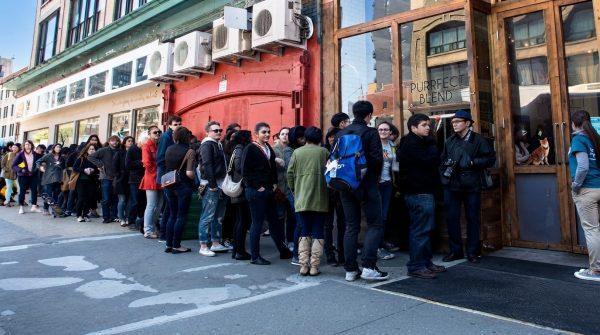
On any given morning in Brooklyn, Queens, or the East Village, you'll find clusters of people—phones out, patience tested—snaking around corners for a coffee, a pastry, or a dessert that exploded on TikTok the night before. This is New York's line culture, and it has become as much a part of the city's culinary landscape as the food itself.
For a bicultural Latino audience, this phenomenon hits close to home. Many of the spots drawing these crowds are Latino-owned ventures, from a coquito brand that built its reputation online to a Jackson Heights bakery that has served the neighborhood for decades. The line outside their doors is both a triumph and a test.
The wait is the experience
Waiting in line is no longer just a hurdle—it's part of the allure. A recent survey by Coefficient Capital found that 60% of Gen Z and 48% of millennials are willing to wait over 30 minutes to get into a trendy spot. The wait itself becomes a shared ritual, a story to tell, and a way to signal that you're in the know.
Some even outsource the wait. Services like TaskRabbit now let people pay others to hold their place in line, turning patience into a commodity. It's a far cry from the days when you'd just walk into your local panadería and grab a cafecito without a second thought.
But this new dynamic is reshaping neighborhoods. While some businesses thrive on the digital spotlight, others struggle to compete. The Economic Development Corporation reports that the influx of crowds can bring economic pressure to communities that aren't prepared for the sudden attention.
Small businesses on the front lines
For independent operators, the viral trend is a double-edged sword. On one hand, a single viral post can bring in customers from all five boroughs. On the other, it can overwhelm a small shop that isn't built for the rush, and it can distort the local economy.
Take Coquito Lady, an artisan venture that has leveraged digital visibility to boost traditional Caribbean flavors. Or Cafecito on the Lower East Side, which balances daily commercial pressure with its neighborhood identity. These businesses are navigating a new reality where algorithms dictate who gets the spotlight.
Local chambers of commerce are stepping in, offering workshops to help small businesses integrate digital tools without losing their community essence. The message is clear: authenticity and neighborhood roots offer a sustainable advantage against the volatility of internet fads.
A tale of two neighborhoods
The divide is stark. In Bushwick, Claudia's has become a destination for its authentic offerings, drawing lines that stretch down the block. Meanwhile, in Woodside, Pupusería Izalco remains a beloved local spot, prioritizing community connection over the pursuit of digital fame. Both approaches have merit, but they reflect different strategies in a city where the line culture is rewriting the rules.
Urban development experts note that this trend creates a split between hyper-connected locals and traditional businesses. Yet, as the hype fades, culinary authenticity tends to prevail. The lines may shorten, but the memories—and the loyal customers—remain.
For New York's Latino communities, this is a moment of both opportunity and caution. The same digital platforms that can make a coquito brand go viral can also threaten the mom-and-pop shops that have been the backbone of our neighborhoods for generations. It's a delicate balance, but one that many are learning to navigate.
As the city moves into 2026, the line culture shows no signs of slowing. But for those who call these neighborhoods home, the real story isn't just about what's at the end of the line—it's about the community that forms along the way. And that's something no algorithm can replicate.