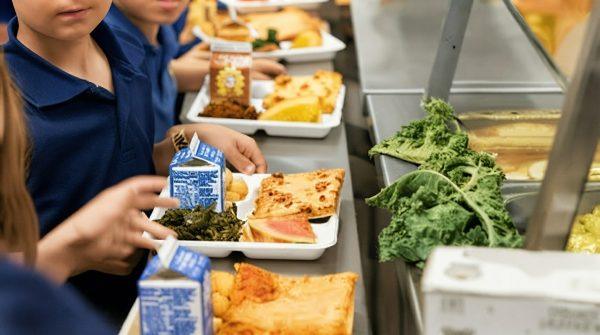
Across the United States, a quiet crisis is unfolding in school cafeterias. Recent federal cuts to the Supplemental Nutrition Assistance Program (SNAP) are not only leaving pantry shelves emptier at home—they are also putting the daily school meals of over one million children at risk. A new report from the Center on Budget and Policy Priorities reveals that declining enrollment in SNAP directly threatens the automatic eligibility that many students rely on for free or reduced-price breakfast and lunch.
For many Latino families, especially those in states like Texas, California, and Florida, SNAP has been a lifeline. But as the federal government shifts more of the financial burden onto states, local school districts are being forced to tighten their belts. They are re-evaluating eligibility criteria, absorbing funding shortfalls, and in some cases, cutting back on meal distribution capacity. The result: more kids showing up to class hungry, which inevitably affects their ability to learn.
A domino effect from Washington to the lunch line
The recent legislative package known as the One Big Beautiful Bill introduced stricter work requirements for SNAP recipients, a move that has had immediate ripple effects. Child advocacy groups report that as families lose their SNAP benefits, schools are seeing a corresponding drop in the number of students who qualify for meal reimbursements. This creates a double blow: families struggle to put food on the table, and schools lose the federal funding that keeps their meal programs running.
Clarissa Hayes, deputy director of child nutrition programs at the Food Research and Action Center, warns that these changes will increase hunger in classrooms. "When parents lose their monthly grocery benefits, household food insecurity rises sharply," she says. "That directly impacts a child's focus and academic performance throughout the school day."
The financial strain is real. According to the Center for American Progress, families who lose free meal eligibility may have to spend roughly $1,000 more per student each year. For households already navigating economic instability, that is a heavy load. Shoemaker DeMio, a senior policy analyst at the center, notes that this amount represents a severe challenge for families who are already making impossible choices between paying utility bills and buying groceries.
Surveys by No Kid Hungry highlight these tough trade-offs. Parents are skipping meals themselves, rationing food, and relying on community food drives to make ends meet. Meanwhile, school nutrition directors are scrambling to find alternative funding—grants, private donations, anything to keep the cafeteria doors open.
States that are bucking the trend
Not every state is feeling the pinch equally. Some have stepped up to protect universal free school meals, insulating their students from federal policy swings. California, for instance, continues to provide free meals to all students, shielding them from the chaos. Colorado, Maine, Massachusetts, Michigan, Minnesota, New Mexico, New York, and Vermont have also enacted laws to maintain universal meal programs, using state funds to cover rising costs and keep every child fed.
These states are proving that a safety net can be woven even when the federal government pulls threads. But in states without such protections, the burden falls on families and local communities. As one school administrator in Texas put it, "We're doing everything we can, but the math doesn't work when you lose thousands of dollars in reimbursements overnight."
Administrative hurdles and hidden costs
Even for families who might still qualify for free meals, the new rules create bureaucratic obstacles. Updated federal mandates require extensive paperwork to prove eligibility, and while there is a 30-day grace period for children already enrolled, the process is daunting. For low-income households, many of whom are Latino and may face language barriers or lack access to digital tools, these administrative hurdles can be insurmountable.
The impact extends beyond the cafeteria. When children lose access to reliable meals, their health suffers, and so does their ability to succeed in school. Public health coalitions argue that diminishing nutritional support during critical developmental stages is a short-sighted policy that will have long-term costs for society.
Congressional leaders defend the cuts as necessary fiscal restructuring, but the human toll is undeniable. As the stigma around SNAP usage persists, many families are reluctant to seek help even when they need it most. And with some states restricting how assistance can be used, the safety net is becoming more tangled.
For Latino communities, where food is often at the heart of family and culture, this is not just a policy issue—it's a daily reality. As the San Fernando Valley lifeline shows, community organizations are stepping up, but they cannot replace a robust federal commitment.
The clock is ticking. With each passing day, more children are losing access to the meals they once took for granted. It's time for policymakers to listen to the advocates, the parents, and the kids who are counting on a brighter, well-fed future.