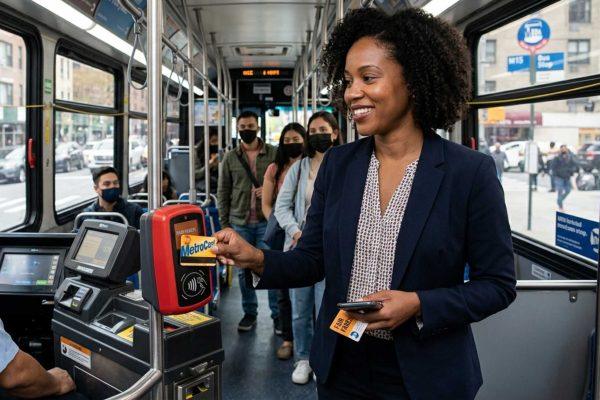
For many working families across the five boroughs, the daily commute is a financial strain that adds up quickly. A proposed City Council bill seeks to ease that burden by making it simpler for low-income New Yorkers to access the existing Fair Fares NYC discount, which cuts subway and local bus fares in half.
Introduced by Council Member Crystal Hudson, the legislation (Int. 0248-2026) would allow the Department of Social Services to use information already provided during SNAP (Supplemental Nutrition Assistance Program) applications to fast-track enrollment into Fair Fares—provided applicants give explicit consent. This is not a new discount, nor does it mean automatic enrollment for all SNAP recipients. Instead, the goal is to remove the administrative hurdles that keep eligible riders from claiming the 50 percent fare reduction they already qualify for.
How the streamlined process would work
Under the current system, SNAP recipients must separately apply for Fair Fares, often submitting paperwork that duplicates what they've already given to the city. The new bill would let the city share verified SNAP data with the Fair Fares program, cutting down on redundant steps. If passed, the Department of Social Services would also send semi-annual notifications to SNAP recipients who haven't yet enrolled, explaining the savings and walking them through the registration process via ACCESS HRA or local benefit centers.
This approach mirrors efforts in other cities to integrate benefits enrollment, and it could be a game-changer for communities where transit costs eat into already tight budgets. For many Latino families in neighborhoods like Washington Heights, Corona, or Bushwick, the subway isn't just a convenience—it's the lifeline to jobs, school, and family obligations.
Who qualifies for Fair Fares
To be eligible, applicants must be between 18 and 64 years old, live in one of the five boroughs, and have a household income at or below 145 percent of the federal poverty guidelines. For 2026, that means earning no more than $23,940 for a single person and $49,500 for a family of four. Importantly, the program is open to all qualifying residents regardless of immigration status, which matters in a city where many immigrant communities rely on public transit.
The bill also requires the Department of Social Services to report annually to the City Council on usage and outreach, ensuring accountability and allowing the city to measure whether the streamlined process is actually reaching people.
Transit equity has been a recurring theme in New York politics, and this bill is another step toward making the system fairer. As the MTA continues to modernize stations—like the recent upgrades in Lower Manhattan—affordability remains a separate but equally critical issue. For those who qualify, the 50 percent discount can mean hundreds of dollars in savings each year, money that can go toward rent, groceries, or other essentials.
Council Member Hudson has emphasized that the bill is about efficiency and dignity, not just savings. By reducing bureaucratic friction, the city acknowledges that applying for benefits should not be a second job. The proposal has drawn support from transit advocates and community groups who see it as a practical fix for a persistent problem.
If the bill becomes law, it could also serve as a model for other cities with similar programs. But for now, the focus is on New York, where the daily grind of the subway is a shared experience across every borough. For the thousands of SNAP recipients who are already eligible but not enrolled, this legislation could be the difference between paying full fare and keeping a little more in their pockets each month.