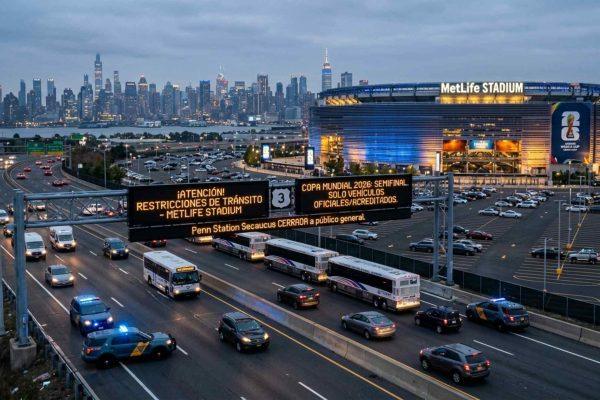
As the 2026 FIFA World Cup approaches, New York and New Jersey are preparing for what officials describe as the greatest logistical challenge in recent memory. With MetLife Stadium set to host the semifinals and final, regional authorities have unveiled a series of massive transportation restrictions aimed at managing an expected influx of hundreds of thousands of visitors.
According to the official FIFA schedule, the most critical days will be June 22 and June 30, when the stadium in East Rutherford, New Jersey, will host the tournament's semifinals and final. During these dates, Penn Station in Secaucus—a key transit hub for fans traveling to the stadium—will be closed to the general public for four hours before and three hours after each match. This measure, announced by regional authorities, is designed to streamline crowd control and ensure security for the global event.
Fare Hikes and Transit Adjustments
NJ Transit has estimated that some 40,000 fans will arrive at MetLife Stadium via public transportation on match days, a volume far exceeding typical game-day traffic. To manage this surge, the agency will implement extraordinary services, including increased train frequency and additional security checks. However, these measures come at a cost: round-trip tickets from New York to the stadium will skyrocket to approximately $150, compared to the regular $12.90 fare. This adjustment has already sparked outrage among fans and FIFA, as reported earlier.
The Executive Director of the Port Authority of New York and New Jersey warned that the transportation network will operate at its capacity limit during the tournament. In a statement, the official strongly recommended that workers in the region opt for teleworking on designated dates and urged residents to anticipate trips and postpone non-essential travel to Manhattan or the vicinity of the stadium. This call for flexibility is part of a broader strategy to reduce strain on public infrastructure.
Risks of Informal Transportation
Authorities have also cautioned against relying on informal transportation options, such as unlicensed taxis or ride-share services like Uber, given the expected demand. The official clarified that these alternatives will not offer reliable solutions, emphasizing that “saturation cannot be resolved by resorting to informal services,” which could pose additional risks to users. To address this, an information campaign will be launched at John F. Kennedy, LaGuardia, and Newark Liberty airports, as well as strategic points across New York City, aiming to dissuade the use of unauthorized transportation and prioritize official, supervised services.
For Latino fans traveling from cities like Buenos Aires, México City, or Bogotá, these restrictions may add complexity to their World Cup experience. The region's bicultural audience, accustomed to navigating both local and international transit systems, will need to plan carefully to avoid disruptions.
Security Coordination and Public Appeal
To manage the passenger influx and reinforce security around MetLife Stadium, multiple agencies—including the New York Department of Transportation, the Port Authority of New York and New Jersey, NJ Transit, the Metropolitan Transportation Authority (MTA), and the New Jersey Police—will coordinate joint operations. New Jersey Governor Phil Murphy assured that the regional infrastructure is adequate to handle a record flow, but he warned that citizen cooperation will be decisive. “It is fundamental that residents and businesses collaborate by following the official recommendations,” Murphy said, underscoring the need for collective responsibility.
For commuters who rely on Penn Station Secaucus, the restrictions will reroute daily travel patterns, as detailed in our coverage. The closures will affect not only fans but also local workers and residents, who are advised to adjust their schedules accordingly.
As the World Cup draws closer, the message from authorities is clear: preparation and cooperation are key. Whether you're a soccer enthusiast from São Paulo or a daily commuter from Jersey City, the 2026 tournament will test the region's mobility like never before.