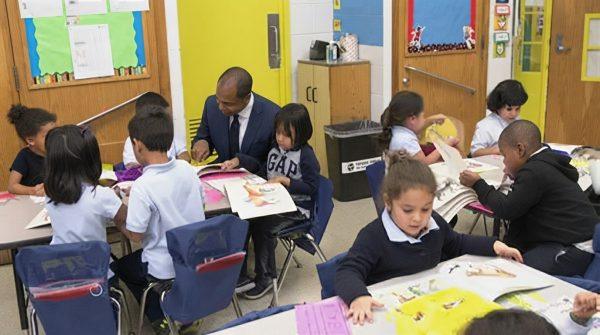
New York City's decision to restrict artificial intelligence tools in public schools has ignited a fierce debate about the future of education and urban competitiveness. The ban, championed by Mayor Zohran Mamdani, affects roughly 600,000 students and has drawn comparisons to regulatory patterns seen in the United Kingdom, where caution often trumps innovation.
A familiar cautionary tale
Observers note that New York's approach mirrors the United Kingdom's historical hesitancy toward technological adoption. In Britain, bureaucratic review committees and risk-averse policies have sometimes slowed progress, leaving cities like London struggling to keep pace with global hubs. Now, New York appears to be following a similar path, raising concerns about the city's ability to prepare its youth for a rapidly evolving job market.
"The ban is a well-intentioned but misguided step," says Samiksha Bhattacharjee, director of Ladies of Liberty Alliance UK and a contributor to Young Voices UK. "It treats AI as a threat rather than a tool, and in doing so, it risks leaving public school students behind."
Equity concerns at the heart of the debate
The policy has also exposed deep structural inequalities. While students from affluent families in Manhattan can access private AI tutoring and enrichment programs, their peers in the public system face new restrictions. This digital divide, experts argue, could widen the achievement gap and undermine the city's commitment to equitable education.
"We're creating a two-tiered system," warns Maria Fernanda López, an education policy analyst based in Bogotá. "Those with resources will find ways to learn these skills, while others will be left out. That's not just an educational failure; it's a social one."
Teacher union leader Michael Mulgrew defends the measure, citing the risks of unregulated AI use during formative years. "We have a responsibility to protect students from potential harms," he said. But critics counter that outright bans rarely work and often push usage underground, where it's harder to monitor and guide.
Global comparisons and the path forward
International examples offer a stark contrast. In Singapore, Bengaluru, and Seoul, AI is being integrated into classrooms as a complement to traditional teaching, with a focus on experimentation and adaptation. These cities view AI literacy as a core skill for the 21st century, not a threat to be avoided.
"The question isn't whether to use AI, but how to use it responsibly," says Bhattacharjee. "New York should be leading that conversation, not shutting it down."
Research from institutions like the Brookings Institution highlights the importance of workforce development and administrative productivity in urban economies. Cities that fail to adapt risk losing their competitive edge, a lesson that Britain has learned the hard way.
For Latino families in New York, the stakes are particularly high. Many rely on public schools as a pathway to opportunity, and restrictions on AI access could hinder their children's ability to compete in a tech-driven economy. Community leaders are calling for a more nuanced approach that balances safety with innovation.
"We can't afford to be left behind," says Carlos Rivera, a parent organizer in Queens. "Our kids need every tool available to succeed, and that includes understanding how to use AI effectively."
As the debate unfolds, the city faces a critical choice: embrace a forward-looking strategy that prepares students for the future, or retreat into caution and risk repeating the mistakes of others. The outcome will not only shape New York's educational landscape but also send a signal to cities across the Americas about the value of technological adaptation.
For now, the ban stands, but the conversation is far from over. With pressure from parents, educators, and experts, the city may yet find a middle ground that prioritizes both safety and opportunity.