If you've ever told someone to get down from the car or asked them to make the line at Publix, you're not alone—you're speaking Miami English. This distinct way of talking, shaped by decades of Latino influence, has become so ingrained that even native English speakers in South Florida use it without thinking. Linguists from Florida International University have been studying this phenomenon for over a decade, and they say it's more than just slang: it's a full-fledged dialect.
What Makes Miami English Different?
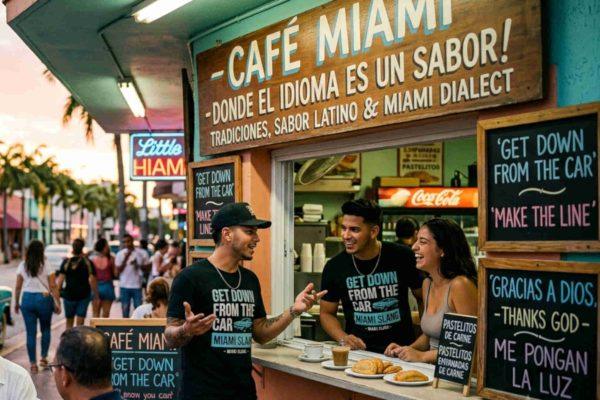
Unlike Spanglish, which mixes Spanish and English words, Miami English relies on calques—direct translations of Spanish phrases that keep their original grammar. For example, instead of saying 'get out of the car,' locals say 'get down from the car,' mirroring the Spanish bajarse del carro. Similarly, 'make the line' comes from hacer la fila, and 'thanks God' is a literal take on gracias a Dios. These expressions have become so natural that many residents don't realize how unique they are until they leave the 305 area code.
Phillip M. Carter, director of the Center for Humanities in an Urban Environment at FIU, explains that this dialect is the primary form of communication for people born in South Florida. 'It's not just bilingual speakers,' he says. 'Native English speakers who grew up here have adopted these structures because they're part of the cultural fabric.'
Everyday Phrases That Define Us
You might hear someone say 'me pongan la luz' to ask for the light to be turned on, or 'make a party' instead of 'throw a party.' These aren't errors—they're reflections of a community where Spanish and English coexist daily. The influence is so strong that even in places like Miami's World Cup viewing spots, you'll hear a mix of languages that feels completely natural.
This linguistic evolution has deep roots. Since the massive arrival of Cuban exiles after 1959, Spanish has been a pillar of Miami's identity. Over time, that influence spread beyond bilingual households into the broader culture. Today, whether you're grabbing coffee in Little Havana or shopping in Brickell, you'll hear Miami English in action.
A Dialect With History
Some might dismiss these adaptations as mistakes, but language history shows that calques are a normal part of evolution. Just like the English word 'dandelion' comes from the French dent de lion (lion's tooth), Miami English is a living example of how languages borrow and transform. For Latinos in Miami, this dialect is more than a curiosity—it's a marker of identity.
As the city continues to grow, with events like Inter Miami hosting the 2026 Campeones Cup, the blend of cultures only deepens. Miami English isn't going anywhere; it's becoming the city's unofficial language, proof that Latino influence doesn't just shape our customs—it redefines how we communicate.