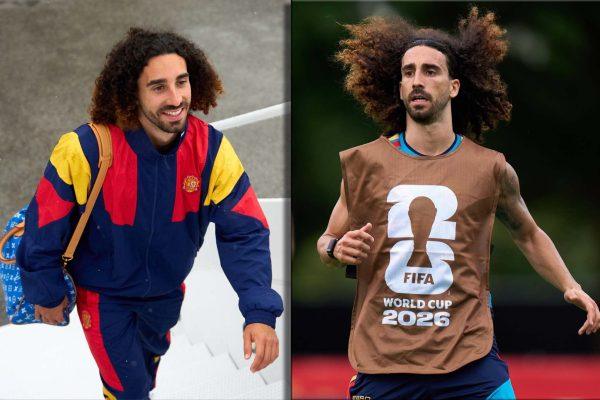
Marc Cucurella, the Spanish defender known for his relentless energy and unmistakable curly mane, might have more than style on his side. A recent study from Loughborough University suggests that his voluminous curls offer a genuine physiological advantage: they help regulate body temperature under extreme heat by blocking solar radiation.
Published in the Proceedings of the National Academy of Sciences, the research tested different hair types on a thermal mannequin in a climate-controlled chamber set to 30°C with 60% humidity and simulated sunlight. The results were clear: tightly curled hair, like Cucurella's, significantly reduced heat absorption compared to straight hair or a bare scalp.
How Curly Hair Cools the Body
The study found that dense, curly hair creates an insulating barrier that limits solar heat from reaching the skin. While a bare scalp allows more sweat to evaporate, it also forces the body to use more water to stay cool. In contrast, curly hair reduces the amount of sweat needed to maintain brain temperature, making it a natural adaptation for hot climates.
“The geometry of curly hair is key,” the researchers noted. “It allows air to circulate while shielding the cranium from direct thermal absorption.” This evolutionary trait, once crucial for early hominids in Africa, now gives elite athletes like Cucurella a subtle edge during matches played under intense sun.
The experiment recorded that tightly curled hair reduced solar heat intake by more than 150 W/m² compared to a bare scalp. At running speeds, it was the only hair texture that allowed the head to lose heat even under artificial sunlight, turning the thermal balance positive.
For context, Cucurella’s high-energy style has already made headlines for other reasons—like when he buried a coin on the pitch before the 2026 World Cup final, a ritual that sparked curiosity among fans.
Evolutionary Roots and Athletic Performance
The findings highlight how human hair diversity is not just aesthetic but functional. Curly hair likely evolved to help early humans conserve water while staying active under the African sun. Today, that same trait can benefit footballers, runners, and outdoor workers in hot regions across Latin America, from the llanos of Colombia to the sertão of Brazil.
Researchers acknowledge that mannequin models don't fully replicate human sweating or hair density variations. Future studies will test how these traits perform in colder climates, but for now, the message is clear: Cucurella’s curls are more than a trademark—they’re a tool.
This isn't the first time science has looked at sports and culture through a Latino lens. From Shakira's kids studying music with a Venezuelan teacher to the quinceañera in Medellín that sparked Karol G and J Balvin's bond, the intersection of heritage and performance runs deep.
As the football world prepares for more tournaments in hot climates, Cucurella’s curls might just be the next frontier in sports science—a reminder that sometimes, the best innovations are already part of who we are.