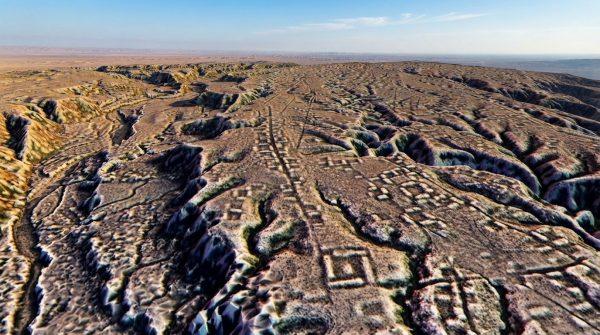
For decades, the Amazon has been portrayed as a pristine wilderness, a place where human impact was minimal before European contact. But a new study, published in Nature, flips that narrative on its head. Using airborne laser scanning, an international team of researchers has mapped thousands of monumental earthworks buried under the dense canopy, revealing a complex network of settlements that once thrived across the region.
The survey covered more than 4,400 square kilometers of jungle in the Brazilian state of Acre, near the border with Peru. What emerged is a landscape shaped by human hands: geometric ditches, raised causeways, and fortified villages arranged in deliberate patterns. These are the remnants of what researchers now call the Aquiry civilization, a culture that flourished between 1,500 and 500 years ago.
A population boom in the tropics
The scale of the discovery is staggering. The team estimates that between 1.25 million and 3 million people inhabited this part of the Amazon during the early centuries of our era. That's a population density of up to 32.6 people per square kilometer in the core area—far higher than previous estimates, which often assumed the tropical lowlands were sparsely populated.
“This completely rewrites what we thought about pre-Columbian demographics,” said Dr. Carla Jaimes Betancourt, an archaeologist at the University of Bonn and a lead author of the study. “These were not isolated, nomadic groups. They built cities, managed forests, and shaped their environment in sophisticated ways.”
The project, backed by the Finnish Institute for Latin American Studies, used LiDAR (Light Detection and Ranging) technology to penetrate the forest canopy. The sensors fire millions of laser pulses, measuring the time it takes for each to bounce back, creating a detailed 3D map of the ground below. This technique reveals structures that are invisible to the naked eye and even to conventional aerial photography.
Architectural sophistication
The earthworks show a level of planning that suggests strong social organization. The geometric patterns—circles, squares, and interconnected lines—are not random. They align with astronomical features and are often connected by causeways, indicating a regional network of trade and communication.
“The precision of these designs is remarkable,” said Dr. Eduardo Neves, an archaeologist at the University of São Paulo who was not involved in the study. “It shows that these communities had a deep understanding of engineering and a collective effort to reshape their surroundings.”
The findings also challenge the idea that the Amazon was a “counterfeit paradise” that couldn't support large populations. Instead, the evidence points to a region that was actively managed, with fertile soils enriched by human activity—a practice known as terra preta, or dark earth.
What lies beneath the canopy
The LiDAR data revealed more than just earthworks. It showed evidence of ancient roads, canals, and even agricultural fields, suggesting a complex society that thrived for centuries. The researchers identified over 2,000 distinct structures, ranging from small mounds to massive ceremonial centers.
“This is just the tip of the iceberg,” said Dr. Jaimes Betancourt. “We've only mapped a fraction of the Amazon. There are likely thousands more sites waiting to be discovered.”
The team plans to extend their surveys to neighboring states like Rondônia and into parts of Bolivia and Peru, hoping to create a comprehensive map of ancient Amazonian settlements. They also emphasize the importance of ground-truthing the LiDAR data with traditional archaeological fieldwork.
“LiDAR gives us a bird's-eye view, but we need to walk the ground to understand the full story,” said Dr. Neves. “It's a collaborative effort between technology and traditional archaeology.”
The discovery has profound implications for our understanding of the Amazon's history and its future. It shows that the forest is not a pristine wilderness but a cultural landscape, shaped by millennia of human interaction. This knowledge could inform modern conservation efforts, recognizing the value of indigenous knowledge and sustainable land management.
As the research continues, one thing is clear: the Amazon is full of surprises, and its history is far richer than we ever imagined. For those interested in the broader context of Latin American heritage, this discovery echoes the hidden colonial towns that dot the borderlands, each with its own story to tell.
The study also highlights the importance of international cooperation in preserving this cultural heritage. As more sites are identified, there is a growing need to protect them from deforestation and development. The researchers hope their work will inspire new policies to safeguard these ancient treasures.
“This is not just about the past,” said Dr. Jaimes Betancourt. “It's about recognizing the legacy of these civilizations and ensuring that their story is told for generations to come.”