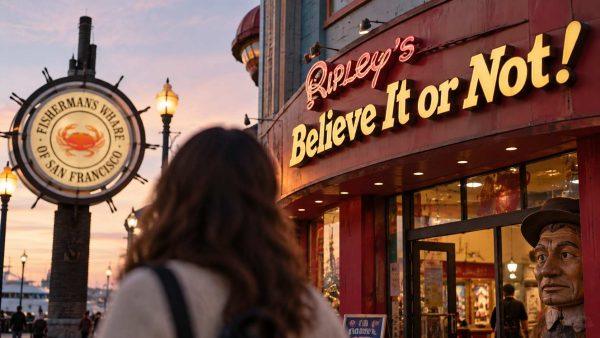
San Francisco's Fisherman's Wharf has always been a place of constant motion—cable cars clanging, sea lions barking, sourdough bread baking. But some things felt like they'd last forever. Ripley's Believe It or Not! was one of them. After nearly six decades of welcoming the curious, the Odditorium is set to close its doors before the end of 2026.
Since 1967, the attraction has been a staple of the Wharf experience, drawing visitors with its collection of more than 400 unusual artifacts, oddities, and a 2,000-square-foot mirror maze. For generations of tourists—many of them Latino families from across the Americas and the diaspora—a trip to San Francisco wasn't complete without a stroll through its quirky halls.
An era ends at the Wharf
The company hasn't announced an exact closing date, but it attributes the decision to the evolving landscape around Fisherman's Wharf and the broader direction of the business, rather than any single event. It's a familiar story in a city that has seen its tourism industry struggle in recent years, with soaring housing costs and shifting visitor patterns reshaping the urban experience.
For many, Ripley's was more than just a museum—it was a rite of passage. Families from México, Guatemala, and beyond would save up for the trip, and the Odditorium offered a mix of wonder and whimsy that transcended language. Its closure marks the end of a chapter not just for the Wharf, but for the countless visitors who made it part of their San Francisco story.
Artifacts with local ties head to auction
The closure isn't just about losing a tourist stop. Ripley's plans to sell several pieces from its collection that have deep San Francisco connections. Among them are Joe DiMaggio's crutches, a chicken-wire portrait of Janis Joplin, and miniature Golden Gate Bridge creations. These items, which have been part of the attraction's charm for decades, will soon find new homes.
It's a bittersweet moment for those who remember the Wharf in its heyday, when it was a bustling hub of seafood stalls, street performers, and quirky museums. The area has seen its share of changes—some welcomed, others lamented—and the departure of Ripley's adds another layer to that transformation.
Could Ripley's return?
The company has left the door open for a possible return elsewhere in San Francisco. For now, though, the closing is another sign of the times for the Wharf, which has been grappling with shifting real estate dynamics and a slow recovery in tourism.
San Francisco's tourism industry has been on a rocky path, and the loss of a long-standing attraction like Ripley's is a blow. But the city's resilience is part of its character. Just as the Wharf has reinvented itself before, it may do so again. For now, visitors have until the end of 2026 to experience the Odditorium one last time—and to say goodbye to a piece of the city's eclectic soul.
As the city continues to navigate its challenges, from budget gaps to the broader economic pressures affecting many urban centers, the closure of Ripley's serves as a reminder of the delicate balance between preserving history and embracing change. For the Latino community, which has long been part of San Francisco's cultural fabric, the loss of this landmark is felt deeply.
Still, there's a sense of hope. The company's hint at a future return suggests that the story isn't over. And in a city known for its ability to surprise, perhaps the next chapter will be just as memorable.