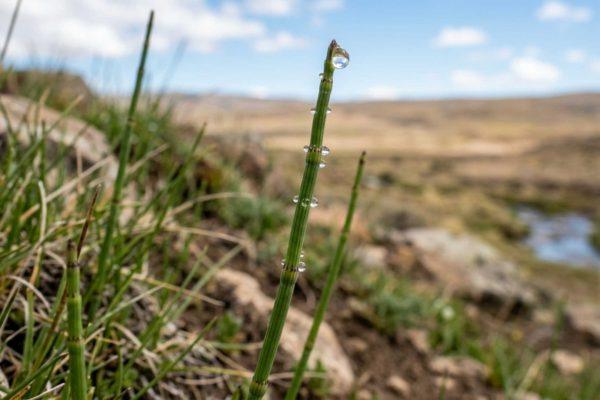
In a discovery that pushes the boundaries of what we thought possible for water on Earth, researchers at the University of New Mexico have found that the humble horsetail plant—a species that has survived for 400 million years—produces water with an oxygen isotope signature so extreme it was previously only seen in meteorites. The findings, led by geochemist Dr. Zachary Sharp, reveal that as water travels up the plant's hollow stem, lighter molecules escape through the walls, leaving behind a concentration of heavy oxygen that intensifies toward the tip. The result is a liquid composition that defies the chemical limits of our planet.
How the Horsetail Rewrites Evaporation Physics
Unlike most vegetation, the horsetail undergoes a unique isotopic transformation. As moisture rises through its stem, the lighter water molecules evaporate first, leaving a residue of heavier oxygen isotopes. This process, amplified in arid regions of the United States, produces enrichment levels that exceed any previous measurement on Earth. The team's data, published in a recent study, show that the tip of the plant contains water with an oxygen isotope ratio so unusual it expands the known chemical range of terrestrial water.
This phenomenon has practical implications for climate science. By correcting evaporation models with these new constants, scientists can now better understand how heat and dry wind influence the chemical signature of desert vegetation. The horsetail, with its ancient lineage, becomes a living laboratory for studying the physics of evaporation in extreme conditions.
Fossil Clues to the Dinosaur Era
The horsetail's fossil record stretches back to the Devonian period, making it one of the oldest surviving plant lineages. Within its tissues, silica phytoliths form—tiny, durable structures that act as time capsules, preserving traces of the humidity that existed millions of years ago. With the new data on oxygen isotope enrichment, researchers can now use these fossils to reconstruct the climate of the dinosaur era with far greater precision.
However, the research team warns that fossil records must be analyzed with caution. The silica footprint does not always perfectly match the water that circulated through the living stem, so interpretations require careful calibration. Still, the potential is enormous: for the first time, scientists have a reliable proxy for ancient humidity levels, which could reshape our understanding of how ecosystems responded to past climate shifts.
This discovery also resonates beyond paleoclimatology. It reminds us that even the most unassuming organisms—plants that have outlasted dinosaurs and ice ages—still hold secrets about the fundamental processes of our planet. For Latino audiences, who often live in regions with rich biodiversity and deep connections to the land, the horsetail's story is a testament to the resilience and wisdom embedded in nature.
As Dr. Sharp noted, "This plant has been around for 400 million years, and it's still teaching us something new about how water behaves on Earth." The findings open a window into the past and offer tools for predicting future climate scenarios, all from a plant that many might overlook as a weed.