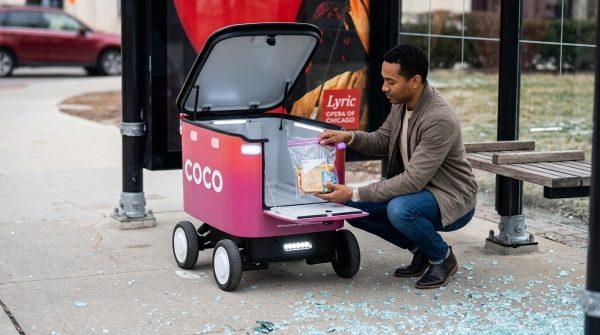
Chicago's sidewalks have become the latest frontier in the battle over digital privacy. Two class-action lawsuits filed on October 9, 2026, in Cook County Circuit Court accuse autonomous delivery robots of quietly collecting sensitive biometric data from unsuspecting residents. The plaintiffs, Mitchell Breidinger and Barry Schain, claim that robots operated by Coco Robotics and Serve Robotics scanned facial and hand geometry while fulfilling food orders—turning a simple dinner delivery into a potential privacy violation.
The lawsuits, first reported by the Associated Press, allege that the robots' high-definition cameras and environmental sensors captured detailed biometric information without the consent of the people they passed. According to the plaintiffs, this data was not just collected but also retained, potentially used to train artificial intelligence models or shared with undisclosed third parties. For many in Chicago's Latino community, who rely heavily on delivery apps for meals from local taquerías and family-owned restaurants, the news raises uncomfortable questions about how much of their personal data is being harvested without their knowledge.
What exactly did the robots capture?
The complaints describe a scenario where robots navigating neighborhood sidewalks used advanced LiDAR sensors and high-definition cameras to record not just the environment but also the people in it. Barry Schain, one of the plaintiffs, says his data was collected on October 4, 2026, during an Uber Eats order—even though he never requested robotic delivery. The lawsuit argues that such data collection violates the Illinois Biometric Information Privacy Act (BIPA), a state law that requires companies to obtain written consent before capturing biometric identifiers like face geometry or hand scans.
Legal experts note that BIPA is one of the strictest privacy laws in the country, allowing individuals to sue for damages of up to $5,000 per violation. However, the law has a nuance: standard photographs are exempt. To win, plaintiffs must prove that the robots captured the precise structural details of a person's face or hands—not just a simple image. This distinction could make or break the case.
Both companies have denied the allegations. A spokesperson for Coco Robotics told reporters that their fleet does not use LiDAR technology in Chicago, while Serve Robotics confirmed to ABC7 Chicago that their navigation systems lack facial recognition capabilities. The companies argue that their robots are designed to avoid obstacles, not to identify individuals.
What this means for consumers
For everyday users of delivery services, the lawsuits serve as a reminder to be vigilant about privacy. Consumer advocates recommend reviewing the privacy policies of delivery apps and keeping records of all transactions, especially if a robot is involved. The outcome of these cases could set a precedent for how autonomous vehicles and robots handle personal data in cities across the U.S., from Los Angeles to New York.
This isn't just a tech story—it's a story about trust. As more Latinos and other communities of color rely on gig economy services, the question of who controls their data becomes increasingly urgent. The Illinois law is a model for other states, but its enforcement depends on cases like this one.
Digital rights advocates are watching closely. They argue that the resolution of these lawsuits will determine whether autonomous delivery services can operate without infringing on privacy. Lawmakers, too, are calling for greater transparency from companies deploying robots in public spaces.
For now, Chicagoans can still get their tacos and empanadas delivered, but they might want to think twice about what else comes with that order. As the legal battle unfolds, one thing is clear: the robots are watching, and the law is catching up.