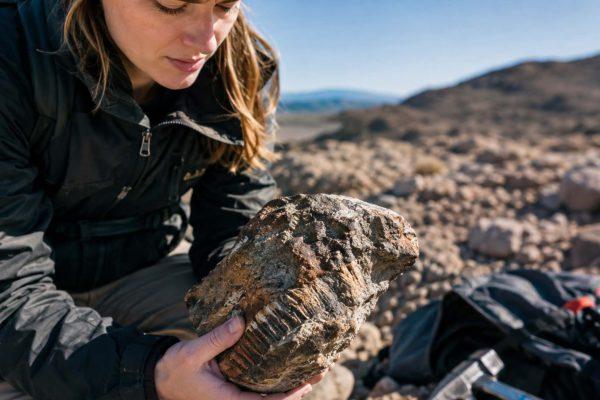
Sometimes the most extraordinary finds hide in plain sight. That’s what happened to Brigid Lynch, a geomorphologist working along a creek in San Mateo County, California. While conducting environmental fieldwork for a habitat restoration project aimed at protecting the endangered California red-legged frog, she spotted an odd-looking object among the river stones. At first, it seemed like just another strangely shaped rock. But after she snapped a few photos and shared them with paleontologists, the truth emerged: she had found an intact upper left molar from a Pacific mastodon (Mammut pacificus).
The discovery, estimated to be at least 10,000 years old, is now recognized as the most complete mastodon molar ever recovered in the San Francisco Bay Area. It’s a remarkable piece of prehistoric California, and it’s about to become a key resource for scientists and educators alike.
A window into the Pleistocene
The Pacific mastodon was formally classified as a distinct species in 2019, following detailed anatomical comparisons. Unlike woolly mammoths, which grazed on open grasslands, these ancient relatives of elephants were browsers. They used their trunks to strip leaves, twigs, and fruits from woody plants, with a particular taste for alder trees. They roamed across what is now Oregon, California, and parts of México, sharing the landscape with saber-toothed cats, dire wolves, Colombian mammoths, and giant ground sloths.
For paleontologists, the molar is more than just a tooth. It’s a time capsule. The specimen has been donated to Stanford University’s Doerr School of Sustainability, where researchers plan to conduct precise radiocarbon dating to establish its exact age. They’ll also analyze microwear patterns and stable isotopes in the enamel to learn about the mastodon’s diet and the region’s climate during the late Pleistocene. That kind of data helps scientists understand how ecosystems responded to past environmental shifts—knowledge that’s increasingly relevant as we face our own climate challenges.
“This is a once-in-a-lifetime find,” said a spokesperson for the Midpeninsula Regional Open Space District, which manages the land where the fossil was discovered. “It’s not just a scientific treasure; it’s a way to connect people with the deep history of this place.”
From creek bed to classroom
Beyond the lab, the molar will also have a life in public education. Stanford scientists plan to create a high-resolution 3D digital scan and print an exact replica for Midpen’s community outreach programs. That means students and residents across the Bay Area will soon be able to see and touch a piece of the region’s ancient past, even if they never step into a museum.
The exact location of the creek is being kept confidential to protect the site from unauthorized digging and to preserve the surrounding habitat. It’s a reminder that these fossils are fragile links to a world we can only imagine—and that protecting them is part of protecting our natural heritage.
For Latinos in California, this story resonates on a deeper level. The lands we now call home have been shaped by millennia of change, and the mastodon’s range extended into what is now México. It’s a shared history that connects the American West with Latin America, a reminder that our roots in this continent run deep—long before borders were drawn.
As California continues to invest in key industries and adapt to new challenges, discoveries like this one ground us in the long arc of time. They remind us that resilience is built into the very landscape we inhabit.
For now, the mastodon molar sits in a Stanford lab, awaiting its next chapter. But its story—and the story of the creature that once chewed with it—is just beginning to be told.