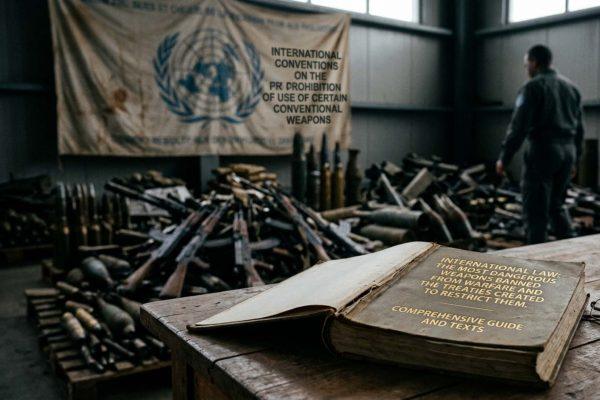
From the trenches of the First World War to the hills of Vietnam, certain weapons have left scars so deep that the world collectively decided they must never be used again. International law, through a series of treaties and conventions, has drawn clear lines around what is acceptable in armed conflict. These rules are not about making war humane—they are about preventing the kind of suffering that spirals beyond any military objective.
Chemical Weapons: A Legacy of Horror
The large-scale use of chemical weapons began during World War I, when armies deployed mustard gas, chlorine, and phosgene. Mustard gas caused horrific burns and secondary infections, while phosgene could silently destroy lungs, often killing days later. The public outcry was immense, leading to the 1925 Geneva Protocol, which banned chemical weapons in battle. This early agreement set the stage for modern restrictions on nerve agents and tear gas, though their use has not entirely disappeared.
Blinding Lasers: A Modern Prohibition
In 1995, Protocol IV of the Convention on Certain Conventional Weapons outlawed weapons designed to cause permanent blindness. These laser weapons, which target the human eye, were deemed too cruel and indiscriminate. However, the treaty allows lasers used against optical equipment, even if they incidentally cause visual damage. This nuance reflects the balance between military necessity and humanitarian concern.
Biological Weapons: An Ancient Threat
Biological warfare is not new. During the colonization of the Americas, there are accounts of smallpox-infected blankets being distributed among indigenous populations, with devastating effects. The unpredictable spread of pathogens makes them particularly dangerous—they can easily backfire on those who release them. The Biological Weapons Convention, in force since 1975, bans the development, production, and stockpiling of such armaments, though concerns about rogue programs persist.
Incendiary Weapons: The Fire That Consumes All
Napalm and other incendiary devices have caused immense suffering in conflicts from World War II to Vietnam. Protocol III of the 1980 Convention on Certain Conventional Weapons restricts their use, particularly against civilian populations. However, they are still permitted against concentrated military targets, a loophole that has been criticized by humanitarian groups.
Landmines and Cluster Munitions: The Lingering Danger
Anti-personnel landmines were banned by the 1997 Ottawa Treaty, yet they continue to maim civilians in post-conflict zones across Latin America and beyond. The treaty requires that any remaining mines be detectable and self-destructing, but the legacy of past conflicts remains. Cluster munitions, banned under the 2008 Convention, scatter bomblets over wide areas, leaving unexploded ordnance that acts like landmines for years. Both weapons are particularly cruel because they do not distinguish between soldiers and children.
Early Precedents: Poisoned Bullets
The idea of banning certain weapons is not new. In 1675, the Strasbourg Agreement between France and the Holy Roman Empire prohibited poisoned bullets, a concept even Leonardo da Vinci had explored. This early pact set a precedent for international arms control, showing that even in an era of limited warfare, there were lines that should not be crossed.
Ongoing Challenges and the Role of International Law
As military technology evolves, so too must the rules. Autonomous weapons, cyber warfare, and new chemical agents pose fresh challenges. The international community, including Latin American nations, plays a vital role in advocating for stronger protections. For instance, Chilean league rules recently made headlines for banning a nickname on a jersey, a reminder that regulations can be both strict and culturally specific.
While the focus is often on the horrors of war, these treaties represent a collective hope that humanity can limit its own capacity for destruction. They are not perfect, but they are a start. As we look toward the future, including events like the 2026 World Cup friendlies that bring nations together, it is worth remembering that diplomacy and sport can also build bridges where weapons once tore them down.
For Latinos across the Americas and the diaspora, these issues resonate deeply. Many of our countries have experienced the scars of conflict, from the Falklands to Central America. Understanding the laws that govern warfare is not just an academic exercise—it is a way to honor those who have suffered and to advocate for a more just world. As Karol G's recent AMAs win shows, our culture can shine on the global stage, but we must also engage with the serious issues that affect our communities.
The road to disarmament is long, but each treaty, each ban, is a step forward. By staying informed and vocal, we can ensure that the weapons of the past do not become the weapons of the future.