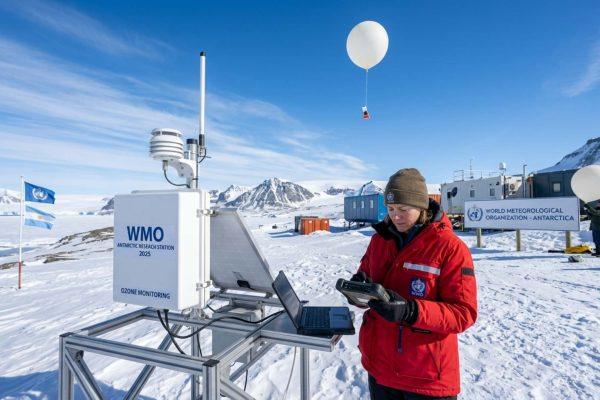
For decades, the Antarctic ozone hole has been a stark reminder of humanity's ability to damage the planet. But a new report from the World Meteorological Organization (WMO) offers a rare piece of good news: in 2025, the hole contracted to one of its smallest sizes since scientists began tracking its severe depletion in 1992. It's a clear sign that international cooperation can heal the skies.
The WMO's latest bulletin confirms that the ozone hole's physical extent ranked as the fourth or fifth smallest recorded in over three decades of monitoring. Both its depth and geographic coverage remained well below the historical averages seen between 1990 and 2010. This is the second consecutive year of such encouraging numbers, suggesting a steady, ongoing recovery.
A victory for global environmental policy
This ecological rebound is a direct result of the Montreal Protocol, the landmark 1987 treaty that phased out the production of ozone-depleting substances like chlorofluorocarbons (CFCs), once common in refrigeration, firefighting foams, and industrial processes. WMO Secretary-General Celeste Saulo called the trend an environmental success story, noting that the upper atmospheric shield has been recovering since the turn of the century. She projects a full restoration in the coming decades, provided global compliance remains strict.
While the ozone layer's recovery is a triumph, scientists are quick to point out that the story isn't over. Ground-level observations across the Northern Hemisphere, including parts of Europe, show that ultraviolet (UV) radiation has increased by up to 20 percent since the mid-1990s. This rise is attributed to reduced cloud cover and longer periods of sunlight, not to a weakening ozone layer. Still, it underscores the need for robust public health measures to protect people from skin damage and other UV-related risks.
The WMO report, released to mark World Ozone Day, also highlights the growing importance of the Kigali Amendment. This extension of the Montreal Protocol targets hydrofluorocarbons (HFCs), which, while not directly harmful to the ozone layer, are potent greenhouse gases—thousands of times more effective at trapping heat than carbon dioxide. Reducing HFCs is crucial in the broader fight against climate change.
Despite the progress, experts warn against complacency. Global observation networks, which track atmospheric chemistry and detect illegal chemical releases, are facing operational declines. Maintaining high-precision instruments in remote polar and tropical regions is essential to ensuring that the ozone layer continues to heal and that no new threats emerge.
For Latin American communities, this story resonates on multiple levels. The region is home to some of the most biodiverse and sun-exposed areas on Earth, from the high Andes to the Caribbean coasts. The recovery of the ozone layer is not just a scientific milestone; it's a public health victory for millions who live under intense UV radiation. As we celebrate this progress, it's a reminder that environmental stewardship is a shared responsibility that transcends borders.
As the ozone layer heals, other environmental challenges loom. The same international cooperation that saved the ozone layer could serve as a model for tackling climate change. The WMO's report is a testament to what can be achieved when nations unite for a common cause. But it also serves as a cautionary tale: the work is far from over.
For now, the shrinking ozone hole is a reason for optimism. It shows that with political will and scientific vigilance, we can reverse environmental damage. The challenge is to apply the same urgency to the climate crisis, ensuring a livable planet for future generations.