The World Cup is more than a tournament; it's a crucible where greatness is forged under the gaze of billions. For Latino fans across the Americas and the diaspora, these players represent not just athletic excellence but the dreams of entire nations. From the streets of Buenos Aires to the favelas of Rio, their stories resonate deeply. Here, we honor 15 legends who didn't just play the game—they changed it forever.
The Pillars of the Soccer Olympus
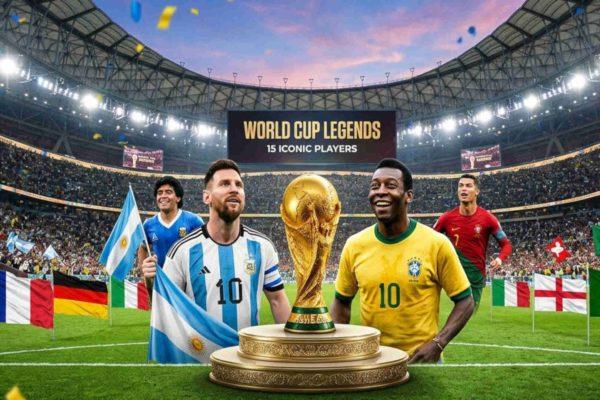
At the summit stands Pelé, the only player to lift the World Cup three times (1958, 1962, 1970). His grace and power made him the ultimate symbol of the tournament. Close behind is Lionel Messi, whose 2022 triumph with Argentina completed a legacy that had long seemed destined. After years of heartbreak, Messi's leadership in Qatar silenced doubters and cemented his place among the immortals. Ronaldo Nazário, the Brazilian phenomenon, wrote his own redemption story in 2002, overcoming career-threatening injuries to lead his country to a fifth title.
From Maradona's Magic to Beckenbauer's Authority
Diego Maradona remains the most electrifying figure in World Cup history. His 1986 campaign—highlighted by the 'Hand of God' and a solo goal against England that defied logic—is often called the greatest individual performance ever. Franz Beckenbauer, the elegant German sweeper, redefined defense while captaining West Germany to victory in 1974. Zinedine Zidane, the French maestro, delivered when it mattered most, scoring twice in the 1998 final and leaving an indelible mark with his grace under pressure.
Goalscorers and Defensive Icons
Gerd Müller, 'Der Bomber,' was the most lethal finisher of his era, his 1974 goals powering West Germany. Cafu, the Brazilian captain, is the only player to appear in three World Cup finals (1994, 1998, 2002), a testament to his consistency and leadership. Miroslav Klose holds the all-time scoring record with 16 goals across four tournaments, a quiet assassin who always delivered. Jairzinho remains unique: the only player to score in every match of a winning World Cup campaign (1970). Just Fontaine set an almost untouchable record of 13 goals in a single edition (1958).
New and Old Glories
Garrincha, the joyful dribbler, was instrumental in Brazil's 1958 and 1962 triumphs, his unpredictability mesmerizing defenders. Bobby Moore, England's captain in 1966, elevated defending to an art form. Paolo Rossi had a magical 1982, winning the Golden Boot, Golden Ball, and World Cup in one tournament. Finally, Kylian Mbappé represents the future: his 2018 exploits and 2022 hat-trick in the final prove he's already a legend at 25. For Latino fans, these stories echo the passion of Mexico's World Cup openers and the debates over Mexico's greatest footballer.
These 15 players transformed the World Cup into a stage for human drama. Their legacies remind us that soccer is more than a game—it's a reflection of our cultures, our struggles, and our triumphs. As we look toward 2026, with Mbappé leading the charge, their influence endures.