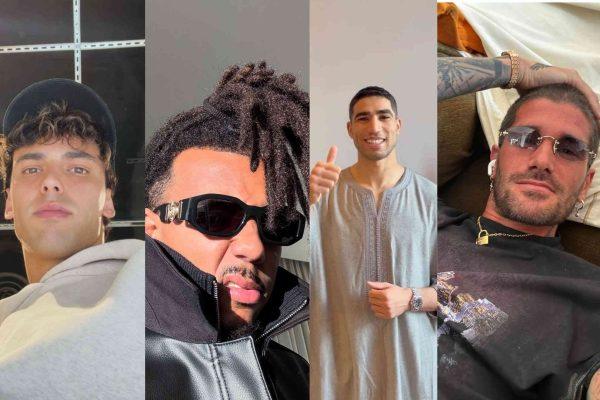
The line between soccer and fashion has blurred into a vibrant runway, and the players heading to the 2026 World Cup are proving that style is as much a part of their game as their footwork. These athletes are not just chasing trophies; they are rewriting the rules of menswear, mixing luxury labels with streetwise attitude. For bicultural Latinos who grew up balancing fútbol and fashion, this moment feels like a homecoming—a celebration of identity that spans from Buenos Aires to Barcelona.
Rodrigo De Paul: Argentina's Style Ambassador
Rodrigo De Paul, the Argentine midfielder known for his relentless energy on the pitch, has become an unexpected fashion icon. His wardrobe is a manifesto of confidence: wide-leg trousers, oversized silhouettes, and statement accessories like Louis Vuitton bags. Recently, he stepped into the spotlight as the face of Rochas, a French luxury house, proving that Argentine flair can translate seamlessly into high fashion. His ever-changing hairstyles and visible tattoos complete a look that feels both rebellious and refined. For fans in Argentina and across the diaspora, De Paul embodies a new kind of criollo elegance—one that doesn't apologize for its boldness.
His influence extends beyond the pitch, as seen in his collaboration with the brand Sh! for a campaign that went viral on Instagram. This isn't just about clothes; it's about how a player from a small town in Argentina can command global attention through style. De Paul's journey mirrors the broader Latino experience of navigating multiple worlds—soccer, luxury, and everyday life—with authenticity.
Versatility and Disruption: Hakimi, Yamal, and Koundé
Achraf Hakimi, the Moroccan defender who plays for Paris Saint-Germain, showcases a chameleon-like ability to shift from tailored gray suits to Under Armour athletic gear. His style reflects a global sensibility, blending North African roots with European sophistication. Meanwhile, Lamine Yamal, the 18-year-old Spanish sensation of Moroccan descent, brings a youthful freshness to the fashion scene. His experimental looks—mixing streetwear with high-end pieces—resonate with a generation that values individuality over conformity.
But the most disruptive force might be French defender Jules Koundé. He has no patience for traditional menswear codes. Faux fur coats, animal prints, and bold jewelry are his trademarks, as seen in his campaign for Messika, the Parisian jewelry house. Koundé's approach challenges the status quo, proving that soccer players can be as daring as any runway model. For Latino audiences, his fearlessness echoes the atrevimiento (audacity) that defines much of Latin American culture—a refusal to be boxed in.
Urban Style and the New Avant-Garde
Portuguese star João Félix and English forward Marcus Rashford take a different route, proving that sobriety can be avant-garde. They favor technical cuts and basic garments elevated by flawless execution and strategic accessories. Rashford, in particular, has solidified his fashionista profile through global collaborations with Burberry, showing that social consciousness and style can coexist. Their approach resonates with the growing economic power of the Latino community, where understated luxury often signals success without ostentation.
These players are not just following trends; they are setting them. Their influence extends to how fans dress for matches, how brands market to bicultural audiences, and how soccer culture itself evolves. The 2026 World Cup, with matches across North America, will be a stage where this fusion of sport and style reaches its peak. For Latinos, who have long navigated the intersection of tradition and modernity, this moment feels particularly resonant.
As the tournament approaches, expect to see more players using fashion as a form of expression. Whether it's De Paul's relaxed luxury, Hakimi's versatility, or Koundé's disruption, these athletes are proving that the pitch is just the beginning. Their style is a conversation—one that speaks to identity, ambition, and the power of being unapologetically yourself.