Argentina's national football team has long been a lightning rod for passion and controversy. While domestic fans celebrate the squad's competitive fire, international audiences often see arrogance and poor sportsmanship. This polarization reached new heights during the 2026 World Cup, where Argentina fully embraced the role of the tournament's villain.
The Roots of Resentment
Argentina's journey to becoming the most hated team didn't happen overnight. It's the result of decades of historic rivalries, provocative celebrations, and iconic controversies. The 2022 World Cup triumph in Qatar completed Lionel Messi's career and initially made the team a beloved underdog story. But once Messi lifted the trophy, that narrative evaporated. Argentina was no longer chasing a poetic ending; it became the defending champion, carrying the swagger of a team that believed it owned the biggest stage.
That attitude is celebrated in Buenos Aires as competitive pride, but outside the country, it's often interpreted as arrogance. Goalkeeper Emiliano Martínez became the clearest example after the 2022 final, when his controversial Golden Glove celebration and repeated mockery of France star Kylian Mbappé transformed global admiration into sharp criticism. The rivalry with France grew even more toxic following Argentina's 2024 Copa América title, when a video showed several Argentine players singing a song targeting French players of African descent, leading FIFA to open an official investigation.
Psychological Warfare on the Pitch
Argentina has a long history of turning soccer games into psychological battles. The 2022 World Cup quarterfinal against the Netherlands was a masterclass in this approach, featuring constant arguments, physical confrontations, and Lionel Messi's now-famous exchange with Dutch striker Wout Weghorst. When Argentina won the penalty shootout, several players celebrated directly in front of their defeated opponents—an action Argentine fans viewed as a response to pre-game comments, but many neutrals saw as unnecessary humiliation.
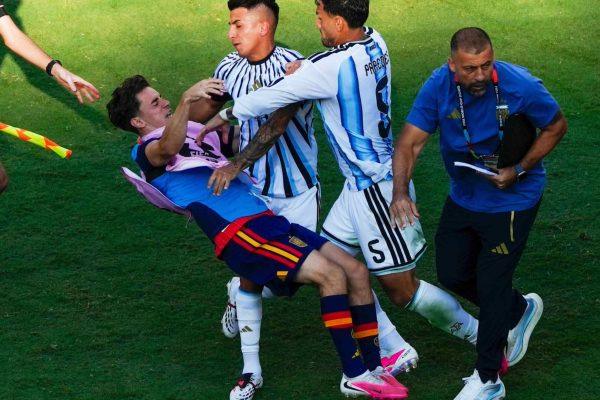
That difference in interpretation follows Argentina everywhere: what Argentines describe as passion and refusing to be intimidated, rival supporters frequently call poor sportsmanship. Argentina rarely leaves the field emotionally neutral, and opponents often feel challenged before, during, and even after the match. The same pattern appeared following the 2026 World Cup final when Spain was celebrating its victory and Leandro Paredes pushed Gavi, triggering another confrontation that strengthened the perception that the team struggles to accept defeat quietly. For more on that incident, see Argentina's Defeat to Spain in World Cup Final Marred by Controversial Gesture.
Decades of Rivalries Have Created Enemies Around the World
Most national teams have one major rival; Argentina has several. Brazil is its historic South American enemy, with the continent's two most successful soccer nations constantly competing over trophies, stars, and regional supremacy. Meanwhile, the rivalry with England combines soccer controversy with political history, marked by the 1966 World Cup quarterfinal, Diego Maradona's "Hand of God" in 1986, David Beckham's red card in 1998, and the background of the Falklands War. The recent revival of this rivalry is explored in Giuliano Simeone Starts for Argentina vs England, Reviving 1998 Beckham Controversy.
Germany defeated Argentina in the 1990 and 2014 World Cup finals, while the Netherlands has carried resentment from several dramatic knockout meetings. France became a modern rival after the 2018 and 2022 World Cups, followed by the controversies surrounding Argentina's celebrations. Every generation appears to produce another country with a clear reason to dislike Argentina.
The Team Embraces Soccer's Darker Arts
Argentina's soccer identity has never been built entirely around elegance. Its greatest teams combine elite technical ability with physical aggression, emotional pressure, tactical fouls, time management, and an ability to provoke opponents. Supporters call it intelligence and competitive survival, while critics call it gamesmanship.
That identity existed during the Diego Maradona era and continued through players such as Diego Simeone, Javier Mascherano, Emiliano Martínez, Rodrigo De Paul, and Leandro Paredes. Argentina can play beautiful soccer, but it is also willing to make a match uncomfortable. It argues every decision, slows the game when necessary, and rarely backs away from confrontation. Those characteristics make the team extremely difficult to defeat and exceptionally easy to dislike.
Messi Protected Argentina's Image, but Only Temporarily
For years, Lionel Messi softened the public perception of Argentina. Even fans who disliked the national team often wanted Messi to win a World Cup, as his quiet personality and extraordinary career gave Argentina a universal emotional storyline that extended far beyond its own supporters. That protection weakened significantly after Qatar 2022. Once Messi became a world champion, neutrals no longer needed to support Argentina to complete his story. The team could now be judged less as Messi's final opportunity and more as the dominant, provocative champion everyone wanted to eliminate.
By the 2026 World Cup, Argentina had fully embraced the role of the tournament's villain, becoming a favorite target for opposing supporters because of its success, swagger, and willingness to push the boundaries of sportsmanship. The pattern is clear: Argentina's blend of elite talent and relentless aggression makes it both feared and despised—a legacy that will likely continue for generations.