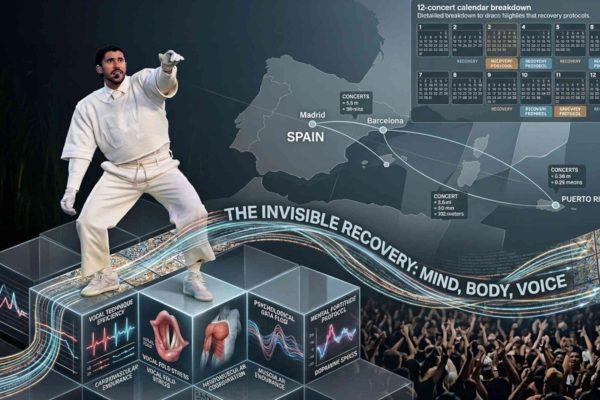
Bad Bunny’s recent run through Spain was nothing short of historic. Over twelve nights in Madrid and Barcelona, more than half a million fans packed into stadiums to witness nearly three hours of non-stop reggaetón, trap, and Puerto Rican flair. But what the audience sees—the lights, the choreography, the guest appearances—is only the final layer. Behind every flawless performance lies a rigorous, almost athletic regimen that keeps Benito Antonio Martínez’s voice, body, and mind in peak condition.
The Voice: An Instrument Under Constant Care
Vocal coach Israel Del Amo, who works with the artist, explains that sustaining such a frantic pace requires more than just talent. “A healthy, well-trained voice, combined with efficient rest management, allows the singer to recover after each show,” he says. The pillars are simple but non-negotiable: proper nutrition, constant hydration, and controlled stress. Del Amo emphasizes that the vocal instrument must be cared for every day, not just on concert nights, to guarantee its durability across a grueling tour.
This invisible training is what separates a good show from a legendary one. Bad Bunny’s team monitors his vocal cords like a pit crew fine-tuning an engine, ensuring that each performance in Madrid or Barcelona sounds as fresh as the first. The result is a sound that feels both spontaneous and meticulously crafted—a balance few artists achieve.
The Body: Endurance Like an Elite Athlete
Physical conditioning is another non-negotiable pillar. Body composition specialist Joel Quintero notes that cardiovascular endurance and neuromuscular coordination are vital for tolerating high-intensity intermittent efforts. “Bad Bunny’s shows are essentially a three-hour sprint with short recoveries,” Quintero explains. “His body has to be ready for explosive movements, constant jumping, and the stamina to keep the energy up for tens of thousands of fans.”
This level of preparation is reminiscent of how top athletes train for marathons or soccer matches. In fact, the artist’s approach mirrors the discipline seen in how Bad Bunny, Rosalía, and Taylor Swift turn concerts into unforgettable experiences, where every detail is calibrated for maximum impact.
The Mind: Staying Grounded Amid Overexposure
Perhaps the greatest challenge for an artist of Bad Bunny’s stature is mental resilience. Psychologist Celia Toledo, who has worked with high-profile performers, explains that dopamine and adrenaline levels reinforce motivation on stage, but the real test comes off it. “Benito’s ability to distinguish his private life from the fiction of social media is what truly allows him to remain focused,” she says. “External criticisms and opinions do not define who he is. What matters is enjoying the present and living in the ‘now’ with honesty.”
This philosophy is not just a talking point—it’s a survival strategy. In an era where every move is scrutinized, Bad Bunny has managed to maintain a sense of authenticity that resonates deeply with his audience. His recent historic encounter with Pope Leo XIV in Madrid only underscored his ability to navigate both the sacred and the secular without losing his core identity.
The Bigger Picture: A Cultural Moment
Bad Bunny’s Spain tour is more than a commercial triumph—it’s a cultural statement. For a Puerto Rican artist to fill stadiums across the Iberian Peninsula, blending reggaetón with flamenco influences and local references, speaks to the fluidity of Latin music today. It also highlights how the diaspora and the homeland can meet on common ground, celebrating rhythms that transcend borders.
As the tour wraps, the lessons from his team’s approach—vocal care, physical training, mental discipline—offer a blueprint for any artist aiming to sustain a global career. But for Bad Bunny, it’s simply part of the job: showing up, night after night, and turning every concert into a party that feels both intimate and monumental.