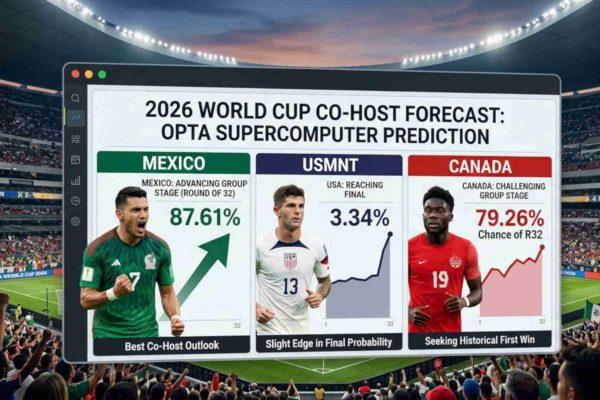
With the 2026 World Cup roster now official, Mexico's path through the tournament has been put under the microscope—not just by fans and pundits, but by Opta's supercomputer. The data-driven forecast gives El Tri an 87.61% chance of advancing past the group stage, the highest among the three host nations. That number reflects both a favorable draw and the advantage of playing in front of a home crowd that will pack stadiums from the Estadio Azteca to Monterrey and Guadalajara.
Javier Aguirre's 26-man squad, which includes veterans like Guillermo Ochoa and rising talents, will face South Korea, Czechia, and South Africa in Group A. Avoiding the kind of early exit that haunted Mexico in Qatar 2022 is the immediate goal, but the ambition runs deeper. The supercomputer gives Mexico a 24.22% chance of reaching the quarterfinals, a stage that would match their best-ever World Cup performance. For a team that has been stuck in the Round of 16 for seven consecutive tournaments, breaking that ceiling is the real prize.
As Mexico and Javier Aguirre go all in on youth for World Cup redemption, the data suggests the strategy could pay off. The supercomputer's model factors in squad depth, recent form, and historical performance, but it also accounts for intangibles like home support. Aguirre has emphasized a more aggressive, attacking style, and the numbers back the idea that this team has the tools to go further than any Mexican side before.
How the US and Canada Stack Up
The United States, under Mauricio Pochettino, enters the tournament with a slightly lower probability of reaching the quarterfinals—around 22%—but a higher chance of winning it all. Opta gives the USMNT a 1.21% probability of lifting the trophy on July 19, a figure that aligns with projections from international football analysts. That edge comes from a deeper pool of players competing in Europe's top leagues and a more favorable bracket path in the knockout rounds, according to the model.
Canada, meanwhile, is the wild card. The Canucks have never won a World Cup match or even scored a point in the tournament, but the supercomputer sees a real opportunity in Group B against Bosnia and Herzegovina, Qatar, and Switzerland. Their probability of advancing past the group stage sits at just over 60%, a number that reflects both the expanded 48-team format and the quality of a squad led by Alphonso Davies and Jonathan David. For a nation still building its football identity, simply reaching the knockout rounds would be historic.
The three host nations will each play their group-stage matches on home soil, a factor that Opta's model weights heavily. Mexico's matches in Mexico City, Guadalajara, and Monterrey are expected to draw some of the most passionate crowds of the tournament. The US will host games across 11 cities, from Los Angeles to Miami, while Canada's matches in Toronto and Vancouver will give the team a chance to grow the sport's footprint in a hockey-dominated market.
Beyond the numbers, the 2026 World Cup represents a moment of cultural significance for the Latino community across the Americas. The tournament will be the first to feature 48 teams, and the first hosted by three nations. For Mexican fans, it's a chance to rewrite a narrative of near-misses and heartbreak. For the US, it's an opportunity to prove that soccer has truly arrived. And for Canada, it's a step onto a global stage that few imagined possible a decade ago.
The supercomputer's forecasts are just probabilities, of course. Football has a way of defying data, especially when la afición is roaring from the stands. But for now, the numbers give Mexico reason to believe that 2026 could finally be the year they break through.