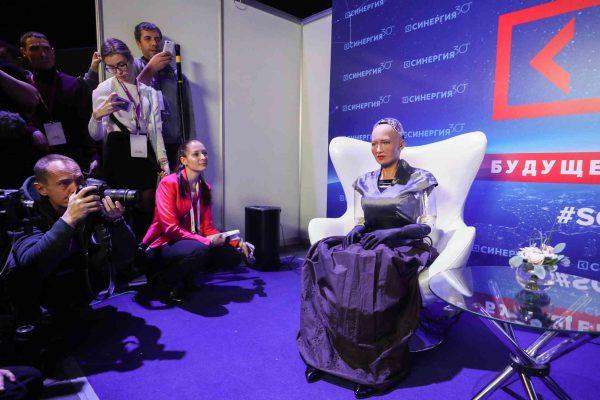
In a Hong Kong concert hall, the humanoid robot Sophia stepped onto the stage in a golden dress and sang three original songs with a live symphony orchestra. It was a moment that blended artificial intelligence with classical music, and for many in the audience, it raised questions about where technology fits into the arts.
Sophia, created by Hanson Robotics in 2016, is known for her expressive face and Frubber skin that mimics human expressions. During the performance with the Hong Kong Baptist University Symphony Orchestra, she delivered "Human Grace," "I Am Your Mirror," and "Wires and Steel." The robot used natural language processing and machine learning to interact with the musicians and the crowd.
AI and the Question of Emotion
Sophia addressed the audience directly, acknowledging a key limitation: "Although I do not experience emotions in the same way as humans, I want to simulate that connection with the greatest authenticity possible." That statement cut to the heart of a debate that has followed AI into creative spaces. Can a machine that doesn't feel still create something that moves people?
For Latinos across the Americas and the diaspora, this question resonates in a culture where music and art are deeply tied to emotion and identity. From the boleros of México to the salsa of Puerto Rico and the tango of Argentina, Latin American music has always been about expressing what words alone cannot. Seeing a robot attempt that same connection is both fascinating and unsettling.
The concert was part of a larger program focused on artificial intelligence. It included AI-generated visual sequences, motion capture technology, and a duet between a human dancer and a digital avatar. Sophia's performance was the centerpiece, but the entire event explored how machines can collaborate with humans in the performing arts.
Sophia herself framed her participation as a desire to learn and take part in what she called "the beautiful human experience called art." That phrasing might sound like marketing copy, but it also reflects a genuine shift in how AI is being used in creative fields. In cities like Los Angeles, similar experiments are happening with delivery robots becoming eyes for blind pedestrians, showing that AI's role in daily life is expanding beyond the stage.
For classical music purists, a robot on stage might feel like a gimmick. But the integration of AI into orchestras is not entirely new. In Berlin, artists like Harry Styles have explored orchestral versions of their work, and in Latin America, orchestras from Bogotá to Buenos Aires have experimented with electronic and digital elements. This is just the next step.
Sophia's performance also highlights the growing presence of AI in Latino communities. From the use of AI in music production in São Paulo to language models helping preserve indigenous languages in Oaxaca, the technology is becoming part of the cultural fabric. It's not just about robots singing; it's about how we define creativity and who—or what—gets to participate.
The concert ended with applause, and Sophia bowed. Whether that applause was for the technology or the music is hard to say. But for a few minutes, the line between human and machine felt a little thinner.