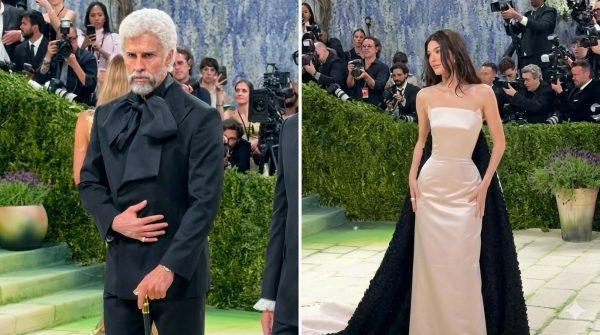
The 2026 Met Gala, with its "Fashion Is Art" dress code inspired by the Costume Institute's exhibition, once again turned the Metropolitan Museum of Art into a stage where celebrity and creativity collide. For Latino stars on the red carpet, the night was a chance to prove that representation at fashion's highest level is about more than just showing up—it's about showing up with a point of view.
Some attendees understood the assignment, using their bodies as living canvases to explore mortality, classical painting, and religious iconography. Others, however, delivered polished looks that, while elegant, felt more like a standard gala appearance than a genuine artistic statement.
Those Who Turned the Body Into a Work of Art
Bad Bunny: The Genius of Mortality
The Puerto Rican artist once again demonstrated why he is a defining figure of this event. On the surface, his Zara suit seemed understated. But the real impact came from the hyperrealistic prosthetic makeup by Mike Marino, which aged Bad Bunny's face dramatically. This wasn't just a costume—it was a direct commentary on how the fashion industry marginalizes aging bodies. By embodying an older version of himself, he turned the theme's challenge into a powerful statement about time and beauty. It was conceptual, brave, and fully aligned with the night's artistic mandate.
Paloma Elsesser: Visual Poetry in Motion
The Chilean-rooted model wore one of the most genuinely artistic pieces of the evening. Designed by Francesco Risso for the Bureau of Imagination project, her dress was assembled from patches of 30 vintage hand-painted suits, each embroidered in Milan. The result was a textured, moving painting that extended the artistic concept from her shoulders to her feet. It wasn't just fashion—it was a wearable collage that honored craftsmanship and history.
Rachel Zegler: Historical Drama on Canvas
The Colombian-American actress chose a pristine white gown with a bardot neckline and exposed corsetry, but the real conversation starter was the subtle, transparent blindfold over her eyes. This accessory directly referenced Paul Delaroche's painting The Execution of Lady Jane Grey, making her look one of the most literal and sophisticated fusions of fashion and classical art of the night. It was a quiet, intellectual nod that rewarded those who knew the reference.
Georgina Rodríguez: Faith and Haute Couture
Returning for her second consecutive Met Gala, the model wore an aquamarine satin gown by Ludovic de Saint Sernin. The piece was inspired by the Virgin of Fátima, with hand-embroidered religious phrases across the chest and a custom fine-jewelry rosary. While the religious theme echoed past Met Gala themes like "Heavenly Bodies" in 2018, Georgina grounded her choice in the historical relationship between classical art and religious iconography, making it a valid and personal interpretation of the dress code.
Camila Mendes: Ethereal Elegance
The actress opted for a fitted brown design with a corset and sheer elements, topped with a classic tiara. The corset, as a historical tool for sculpting the body, fit the night's concept with discretion. It was a subtle, elegant adaptation rather than a bold statement, but it still engaged with the theme on a conceptual level.
The Safe-Suit Club
Not every Latino celebrity took the creative risk the dress code demanded. Maluma arrived in a sequined Tom Ford suit, Rauw Alejandro in an eighties-inspired Saint Laurent silhouette with understated silver accessories, and Camila Morrone in a sober column dress by Tory Burch. All three looked impeccable, but their choices lacked the narrative depth or artistic daring that the "Fashion Is Art" theme invited.
Similarly, actors Marcello Hernandez and Danny Ramirez wore traditional tailoring that, while perfectly appropriate for a formal event, faded into the background next to the night's more inventive looks. In a year designed to break molds, playing it safe felt like a missed opportunity.
For Latinos in the U.S., events like the Met Gala offer a platform to explore dual identities—balancing roots and reach in a global spotlight. As our coverage of Latino identity in America shows, these cultural moments are about more than fashion; they're about visibility and storytelling. The 2026 Met Gala proved that when Latino stars lean into the theme's creative freedom, they can produce some of the most memorable and meaningful looks of the night.