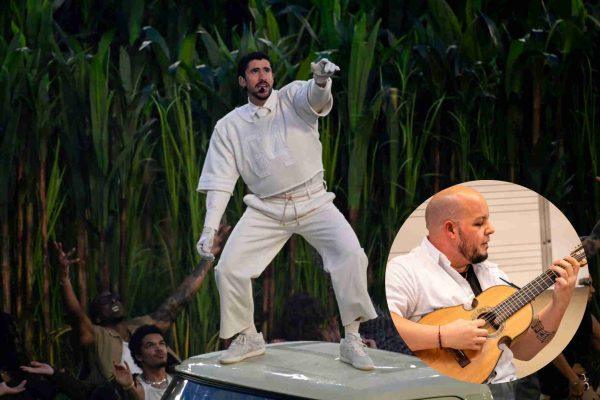
On Bad Bunny's current world tour, a quiet revolution is unfolding in stadiums across Europe and Australia. In the middle of the set, the lights dim, and the unmistakable sound of the Puerto Rican cuatro takes over. The man behind the strings is José Eduardo Santana, a musician from Carolina who has turned a brief solo into a moment of cultural pride and musical mastery.
Santana's role on the Debí Tirar Más Fotos tour began as a creative experiment. He was asked to introduce the track Pitorro de Coco with a short cuatro piece. What started as a few bars has evolved into a nightly ritual that leaves tens of thousands of fans in awe. For Santana, it's not just a performance—it's a mission to elevate an instrument often pigeonholed as a Christmas tradition.
A Cultural Bridge Across Continents
Santana's approach goes beyond technical skill. Each night, he researches the music of the country he's playing in, weaving local melodies into his solos. In Spain, he channeled Paco de Lucía; in Germany, he incorporated Beethoven. This adaptability has turned his segment into a cultural exchange, connecting Puerto Rico's mountain music with audiences in Düsseldorf, London, and Sydney.
“I feel like I'm carrying a baton that was passed to me,” Santana said in a recent interview. “This isn't about fame. It's about showing that the cuatro belongs on any stage, anywhere.” His humility and dedication have earned him the trust of Bad Bunny, who gives him free rein to develop these solos. The result is a moment of silence and admiration from crowds of 60,000 people.
Santana's journey hasn't been easy. Growing up in Puerto Rico, he faced skepticism from peers who saw the cuatro as outdated in an era dominated by reggaeton. But persistence paid off. Today, he stands as a vital link in a chain of artists who have kept the tradition alive, from legendary cuatristas to contemporary innovators. He is quick to credit those who came before him, insisting the instrument belongs to the collective heritage of Puerto Rico.
This tour has also challenged long-held prejudices. For years, the cuatro was associated primarily with parrandas and holiday gatherings. Santana's performances prove its versatility, blending folk roots with urban energy. His solos are a testament to what happens when passion meets rigorous study—the indigenous sound of Puerto Rico can conquer any stage, no matter how massive.
Beyond the music, Santana's presence on the tour is a statement about identity. For bicultural Latinos, seeing a traditional instrument in a global pop context is a powerful reminder that heritage can evolve without being lost. It's a narrative that resonates deeply in cities like New York, Miami, and San Juan, where diaspora communities grapple with maintaining cultural ties.
Santana's work also highlights the collaborative spirit of Bad Bunny's camp. The tour has featured other nods to Puerto Rican culture, from the plena rhythms to the use of local slang. Santana's cuatro is just one piece of a larger puzzle, but it's a crucial one. As he puts it, “This instrument is a treasure that belongs to everyone. I'm just lucky to be the one holding it right now.”
For fans who want to dive deeper into Bad Bunny's cultural impact, check out Bad Bunny's Best Film and TV Roles: A Watchlist for Latino Fans and Bad Bunny Gets a Wax Statue at Musée Grévin Ahead of Paris Shows. The tour continues to make headlines, with recent stops in Paris and Düsseldorf sparking conversations about Latino representation in global entertainment.
As the tour moves forward, Santana remains focused on the task at hand: honoring the cuatro's legacy while pushing it into new territory. Each night, he steps onto the stage with nerves and adrenaline, knowing he's part of something bigger than himself. For the thousands who witness it, his solos are more than music—they're a bridge between generations, cultures, and continents.