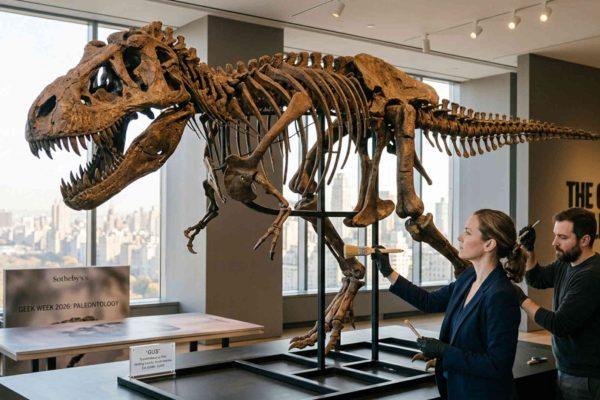
In the world of paleontology, few discoveries capture the imagination like a well-preserved Tyrannosaurus Rex. This July, a specimen nicknamed Gus is set to do just that, hitting the auction block at Sotheby's in New York with an estimated price tag between $20 and $30 million. For Latino audiences across the Americas, where ancient fossils from Patagonia to the Yucatán have reshaped our understanding of prehistory, Gus represents a fascinating chapter in Earth's story—one that speaks to survival, violence, and the relentless march of time.
A Fossil with a Story
Gus isn't just any T. Rex. Unearthed on a private ranch in South Dakota by Gary "Gus" Licking, the skeleton boasts an extraordinary 63% bone completeness, including 183 bony elements. Its skull alone retains 82% of its original bones, complete with dentition, making it a standout among privately held fossils. Only two other specimens—Sue and Stan—have surpassed this level of preservation, cementing Gus as a scientific treasure.
The femur, measuring 128 centimeters, is larger than those of other famous T. Rexes, offering researchers a unique opportunity to study the biomechanics of this apex predator. The skeleton also includes rare elements like a complete pelvis, both humeri, and the delicate furcula, which could unlock new insights into how these creatures moved and grew during the late Cretaceous period.
Scars of a Violent Life
What truly sets Gus apart are the marks of a hard-lived existence. Bite marks and healed fractures on its ribs and right dentary tell a story of fierce territorial battles. These pathologies provide a biological record of the dangers these predators faced in the wooded plains of what is now North America. For paleontologists, such details are invaluable, offering clues about social interactions and survival strategies among dinosaurs.
This auction comes amid a growing trend of high-profile fossil sales. In recent years, specimens like Apex have fetched record sums, with some reaching $45 million. While critics argue that private sales can limit scientific access, proponents see them as a way to fund further research and public exhibitions. Gus, with its estimated value, is poised to become a centerpiece for a private collector or institution.
A Global Fascination
For Latin American readers, the story of Gus resonates beyond its American origins. From the dinosaur-rich formations of Argentina's Patagonia to the fossil sites in Mexico's Coahuila, the region has contributed significantly to paleontology. The discovery of species like the Argentinosaurus or the Mexican Velafrons highlights a shared heritage of ancient life. Gus, though found in the U.S., is part of a broader narrative that connects all of the Americas.
The public will have a chance to see Gus starting in early July at The Breuer in Manhattan, as part of Sotheby's Geek Week—a lineup dedicated to historical science treasures. For those who can't make it to New York, the auction itself will be a spectacle, drawing bidders from around the world.
As the sale date approaches, Gus stands as a reminder of the resilience of life—and the enduring allure of the creatures that once ruled our planet. Whether it ends up in a museum or a private collection, its legacy is secure: a 67-million-year-old survivor, now facing a new kind of battle in the auction room.