Enes Kanter Freedom arrived at Sunday night's WNBA game as a spectator. He left under security escort after a politically charged confrontation that turned the court into a stage for one of the league's most divisive debates.
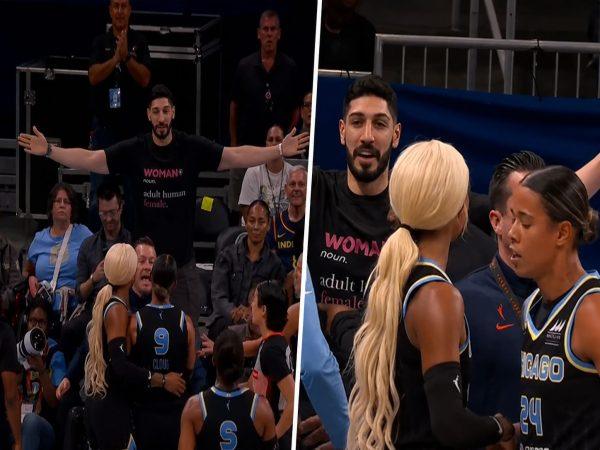
The former NBA center was removed from Wintrust Arena during the Indiana Fever's 113-90 win over the Chicago Sky. The flashpoint came late in the third quarter when Sky guard Natasha Cloud, after scoring, turned toward Freedom and exchanged words with him. Freedom, seated near the baseline in a black shirt reading "WOMAN noun. adult human female," responded and briefly stepped onto the court before security intervened and escorted him out.
What might have been a routine courtside spat carries far heavier weight. Freedom, who played 11 seasons in the NBA, has reinvented himself as a political activist. In recent weeks, he has zeroed in on the WNBA's eligibility rules for transgender athletes. Earlier this month, he announced his intention to declare for the 2027 WNBA Draft, framing it as a challenge to what he calls insufficiently defined rules. Former NBA player Royce White made a similar announcement.
Freedom's argument is straightforward: if eligibility is based on gender identity rather than biological sex, the league would struggle to explain why he couldn't declare. His announcement was never about a comeback—it was a provocation designed to force the WNBA to clarify its position.
Notably, there is currently no transgender player in the WNBA. The controversy revolves around policy and hypothetical scenarios, not an existing athlete taking a roster spot. That distinction often gets lost in the heat of the debate.
The debate moves from the margins to the mainstream
The issue gained traction this summer when Fever guard Sophie Cunningham publicly opposed transgender women competing in women's basketball. Her comments turned a broader national argument into a WNBA story. Freedom then amplified it with his draft announcement.
The league responded when commissioner Cathy Engelbert sent a memo to teams acknowledging the questions and describing the topic as nuanced. Then came Sunday night.
Freedom attended a game involving Cunningham's Fever while wearing a shirt that made his stance explicit. Cloud confronted him, and the scene escalated. Afterward, Freedom cast the ejection as proof that his views were being silenced. Cloud received support from Chicago coach Tyler Marsh, who defended his player and stressed the need to respect WNBA players and the game.
This clash is part of a larger transformation. The WNBA, once a niche league, has exploded in popularity thanks to stars like Caitlin Clark and a new generation of talent. More viewers, bigger crowds, and greater media attention have followed. But so has political scrutiny.
The league has long been a home for outspoken players and a strong connection to Black and LGBTQ communities. Now it's attracting millions of newer fans who don't necessarily share those cultural or political perspectives. That collision has turned the WNBA into a battleground for arguments about race, gender, sexuality, and identity.
The 2026 season has made that clear. Debates over physical play, officiating, and even objects thrown onto courts have punctuated the year. The basketball may be better than ever, but so is the noise around it.
Freedom's ejection doesn't resolve the question he's raising—it guarantees more attention. His proposed draft entry pressures the league to define its eligibility rules precisely, while also forcing it to distinguish between genuine policy discussions and stunts designed to provoke.
For the WNBA, this is an uncomfortable consequence of its new relevance. More people are watching, more money is flowing in, and more national arguments are coming along for the ride. Sunday's confrontation lasted only moments, but the debate that brought Freedom and Cloud face-to-face is far from over.
As the league navigates this terrain, it might look to other sports for lessons. Women's pro baseball is making its own history with Latina pioneers, and courtside clashes are becoming a recurring theme in the WNBA. The challenge is to keep the focus on the game while the world around it shifts.