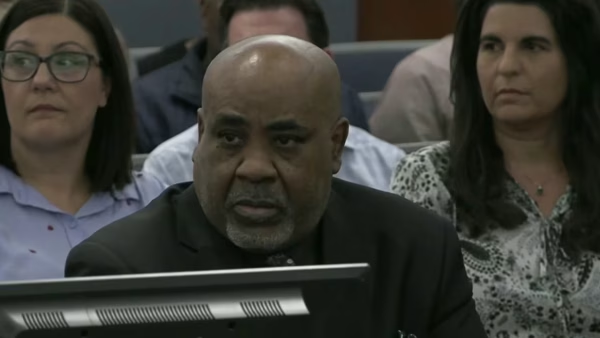
For nearly three decades, the murder of Tupac Shakur remained one of hip-hop's most haunting cold cases. That changed when a Las Vegas jury found Duane 'Keffe D' Davis guilty of first-degree murder with a deadly weapon. Davis, now 63, was not a stranger to the investigation—his ties to the fatal shooting run deep into the gang rivalries that defined Compton in the 1990s.
Who is Duane 'Keffe D' Davis?
Davis was a high-ranking member and 'shot caller' of the South Side Compton Crips, according to authorities. Tupac, at the time of his death, was the face of Death Row Records, whose CEO Suge Knight had close associations with the rival Mob Piru gang. That placed Davis and Tupac on opposite sides of a long-standing feud that stretched across Los Angeles County.
The conflict turned personal on September 7, 1996. After a Mike Tyson fight at the MGM Grand in Las Vegas, Tupac, Knight, and their entourage confronted Orlando 'Baby Lane' Anderson near an elevator. Anderson, Davis's nephew and a South Side Compton Crips member, was beaten in the altercation. Prosecutors argued that Davis, upon learning of the attack on his nephew, organized a retaliation.
Later that night, a white Cadillac carrying Davis, Anderson, and two others pulled up alongside the BMW carrying Tupac and Knight. Gunfire erupted, striking Tupac multiple times. He died six days later at the age of 25.
The case against Davis
Prosecutors did not need to prove Davis fired the fatal shots. Their case rested on his role in orchestrating the attack and supplying the weapon. Davis had previously claimed that Anderson was the shooter, though prosecutors did not identify the gunman at trial. Anderson himself was killed in an unrelated shooting in 1998.
What made this case unique was Davis's own words. Over the years, he discussed the killing in interviews and in his 2019 memoir, Compton Street Legend. Those accounts became key evidence, with prosecutors using his own admissions against him. His defense argued that his stories were exaggerated or fabricated for profit and attention.
On August 31, 2026, the jury deliberated for only a few hours before convicting Davis. The verdict marks the first conviction in connection with Tupac's murder, a case that has haunted fans and investigators alike. Davis intends to appeal and faces the possibility of life in prison.
This case resonates beyond the United States, touching on the broader narrative of Latino and Black communities in Los Angeles, where gang culture and music intersected. For many in the diaspora, Tupac's legacy is intertwined with the struggles and creativity of urban America. His music continues to inspire artists across Latin America, from reggaeton to hip-hop, as seen in the work of figures like Rome Flynn, who explores Afro-Latinidad in his own projects.
The conviction also raises questions about justice delayed, but not denied. For those who grew up with Tupac's lyrics, the closure is bittersweet. As the legal process moves forward, the story of Keffe D serves as a reminder of the consequences of gang violence, a theme that resonates in many Latin American countries where similar conflicts have shaped communities.
While the trial has concluded, the broader cultural impact of Tupac's death remains. His music, and the circumstances surrounding his murder, continue to be analyzed and debated. For now, the conviction of Davis offers a measure of accountability, even if it took three decades to arrive.