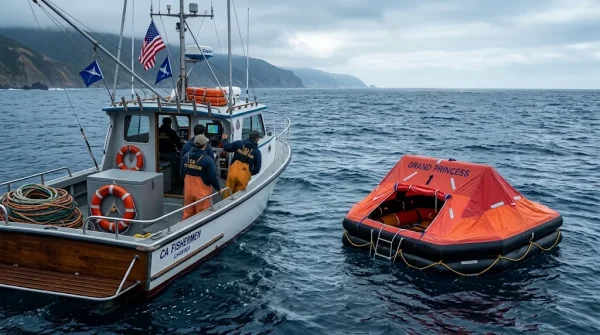
On the morning of November 6, 2026, a routine fishing trip off the Southern California coast turned into a life-saving mission. Sean Norton and Grant Garrett, two seasoned anglers from Newport Beach, were trolling for marlin about 20 miles from Catalina Island when Garrett spotted something unusual bobbing in the swell. At first, it looked like debris, but as they got closer, the shape became unmistakably human.
“I was like, ‘Yeah, that’s a human being. Stop the boat; let’s pull all the lines in,’” Garrett recalled. The crew quickly hauled the exhausted man aboard. He was conscious but severely weakened, having spent an estimated nine to ten hours drifting in the open Pacific after falling from the Royal Caribbean cruise ship Ovation of the Seas around 2:30 a.m.
The survivor, who identified himself as the ship’s pianist, whispered to his rescuers, “Thank you. I thought I was going to die.” Norton and Garrett wrapped him in blankets and radioed for help, speeding back toward shore as Newport Beach lifeguards, led by Battalion Chief Adam Yacenda, prepared to take over his care.
A miracle at sea, aided by El Niño
The U.S. Coast Guard received the distress call from the fishermen and later described the recovery as a miracle, given the vast distance from shore and the hours spent in the water. But there was another factor working in the pianist’s favor: the ocean temperature. Water readings near Catalina hovered around 76°F, unusually warm for November, thanks to one of the strongest El Niño events on record. Scientists noted that Pacific temperatures were running about 5.5°F above historical averages, which likely prevented the onset of severe hypothermia.
“The warm water was a game-changer,” said a marine safety expert familiar with the case. “In normal conditions, a person could succumb to cold water shock within hours. Here, the pianist had a fighting chance.”
Royal Caribbean Group confirmed that the crew member was receiving support and assistance, though they declined to release further personal details. The Coast Guard has launched an official inquiry into how the pianist fell overboard, and investigators are reviewing testimony from the fishermen who made the rescue.
This incident echoes another remarkable Pacific survival story: an 86-year-old sailor and his dog rescued after two months adrift. While the pianist’s ordeal was shorter, it was no less harrowing.
For the Latino community in Southern California, many of whom have deep ties to the sea—whether through fishing traditions in México, Puerto Rico, or the coastal towns of Central America—this rescue resonates. It’s a reminder of the ocean’s power and the bonds that form between those who make their living on the water.
As the pianist recovers, the fishermen who saved him are being hailed as heroes. But Norton and Garrett remain humble, insisting they just did what anyone would do. “You see a person in the water, you stop,” Garrett said. “There’s no other option.”
The Coast Guard continues to investigate, but for now, the focus is on the miracle of survival—and the unlikely role that a warming ocean played in it.