There are listening parties, and then there’s hearing norteño under a simulated galaxy. Grupo Duelo recently brought its latest album, Gravedad, to the Burke Baker Planetarium at the Houston Museum of Natural Science. Fewer than 200 invited guests gathered beneath the dome as space imagery swirled overhead while tracks from the album played. The concept was almost too on the nose: an album called “Gravity” surrounded by stars and planets. But it also points to something bigger happening across música mexicana.
As regional Mexican music has grown from a powerful U.S. Mexican market into one of mainstream music’s most visible forces, artists are increasingly embracing the kind of world-building once reserved for global pop stars: visual identities, destination events, branded environments, and experiences designed as much for the phone camera as for the stage. Grupo Duelo’s planetarium night is a particularly good example because the spectacle didn’t replace the music—it was built around it.
More than an Instagram moment
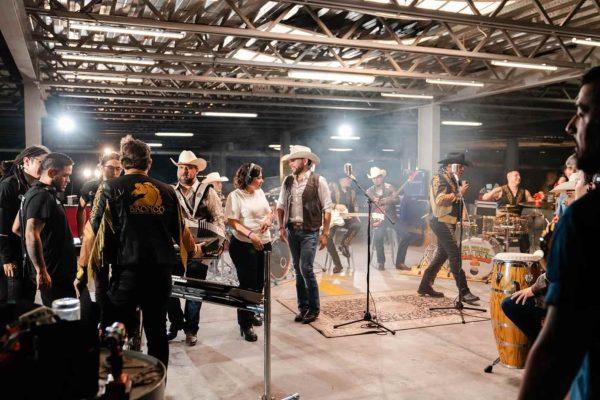
According to the Houston Chronicle, the private event paired several Gravedad tracks with planetarium visuals before Grupo Duelo participated in a Q&A and performed four songs live, including “Te Cura el Tiempo” and “Para Que Ya No Duela.” That intimate gathering comes right before something much larger.
Grupo Duelo is scheduled to play three Houston dates at Toyota Center on August 21, 22, and 23 as part of its 2026 Gravedad Tour. The first two dates sold out, according to the Chronicle, prompting the addition of a third show. That contrast matters: fewer than 200 people under a planetarium dome one week; an arena-scale audience the next.
The strategy recognizes two things contemporary fandom increasingly wants at once: scale and intimacy. A fan may want the arena singalong, but they also want the photograph, the behind-the-scenes clip, or the unusual moment that feels impossible to recreate elsewhere. The planetarium delivers exactly that.
Authenticity doesn’t mean staying in one visual lane
For years, mainstream presentations of regional Mexican music leaned heavily on familiar visual shorthand: boots, hats, ranch imagery, trucks, horses, and rural landscapes. Those aesthetics remain meaningful parts of the culture. But a new generation of artists and audiences has demonstrated that the music doesn’t have to be visually trapped by them.
Corridos can live beside streetwear. Norteño can fill an NBA arena. A Mexican American band can present an album beneath a digital galaxy. That flexibility is increasingly important as the audience expands. Luminate’s 2026 Midyear Report found that nearly one in ten U.S. music streams were in Spanish during the first half of the year. The company also reported that casual U.S. listenership of Latin music had reached 54% in the first quarter—meaning more than half of music listeners surveyed said they engaged with it.
That doesn’t mean all of those listeners understand the difference between norteño, corridos tumbados, banda, sierreño, and the many other styles frequently compressed under a “Latin” label. It does mean the potential audience for these sounds is larger—and when the audience gets larger, presentation gets more ambitious.
The next frontier: the experience around the music
Pop has spent years perfecting album worlds: elaborate pop-ups, fashion collaborations, temporary installations, cinematic album trailers, and tour stages engineered to generate thousands of social clips per night. Regional Mexican music now has the audience power to play in that territory on its own terms.
Grupo Duelo is particularly interesting in this conversation because it’s not a brand-new Gen Z act trying to manufacture novelty. The Texas-founded group has more than two decades behind it. That makes the planetarium experiment feel less like a young artist chasing a trend and more like evidence that the expectations around the genre itself are expanding.
The band can keep the accordion, the emotion, and the songs its audience came for—and still put them in space. That may be where the most interesting evolution is happening. Regional Mexican music has already proved it can fill playlists, charts, and arenas. Now artists are asking a different question: What should this music feel like when fans enter its world?
For Grupo Duelo, at least for one night in Houston, the answer was hasta las estrellas.
This shift isn’t happening in isolation. Across the Latin music landscape, artists are rethinking how they connect with fans. Karol G’s upcoming album announcement shows how global stars are also crafting immersive narratives. And as the Latin Grammys race heats up, the genre’s visual and experiential ambitions are becoming as talked about as the music itself.