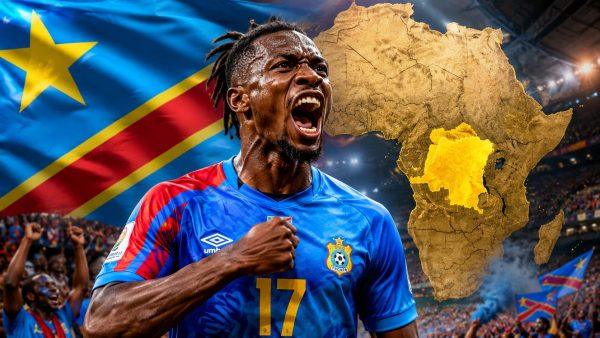
When the Democratic Republic of the Congo beat Uzbekistan 3-1 to reach the knockout stage of the 2026 FIFA World Cup, it wasn't just a football victory—it was a moment of reclamation. For many fans, the run has sparked a simple question: where exactly is DR Congo, and why is its story so layered?
DR Congo sits in Central Africa, one of the continent's largest nations. Its capital, Kinshasa, is a sprawling metropolis that faces Brazzaville, the capital of the neighboring Republic of the Congo, across the Congo River. That detail matters because there are two countries commonly called Congo. DR Congo is the larger one, formerly known as Zaire from 1971 to 1997. The Republic of the Congo is its smaller neighbor to the west.
The country's official language is French, making it one of the most important French-speaking nations in the world. But DR Congo is deeply multilingual: Lingala, Swahili, Kikongo, and Tshiluba are widely spoken, alongside dozens of local languages. This linguistic richness reflects a nation of immense cultural power, despite a brutal colonial history under Belgium and decades of political instability since independence in 1960.
A World Cup History Written in Contrasts
Before this year, DR Congo had appeared at the World Cup only once—in 1974, when it competed under the name Zaire. That team made history as the first Sub-Saharan African nation to qualify for the tournament, but the campaign was a painful one. Zaire lost all three group matches, scored no goals, and conceded 14, including a 9-0 defeat to Yugoslavia that remains one of the heaviest losses in World Cup history.
For more than five decades, that was the country's only World Cup chapter. Now, the 2026 edition has rewritten the script. DR Congo earned its first-ever World Cup win by coming from behind against Uzbekistan, with Yoane Wissa scoring twice in the 3-1 victory. The result sent the team into a Round of 32 clash against England—a matchup that carries enormous weight for Congolese fans, both at home and in the diaspora.
This run is more than a sports headline. For a nation that has endured so much, seeing the national team on this stage is a moment of pride, identity, and visibility. It's a reminder that football can be a powerful lens through which to understand a country's resilience and complexity.
As DR Congo prepares to face England, the stakes go beyond the pitch. This is a team that has already made history, and every minute of this tournament is a chance to tell a fuller story about a nation that deserves to be known for more than its struggles.