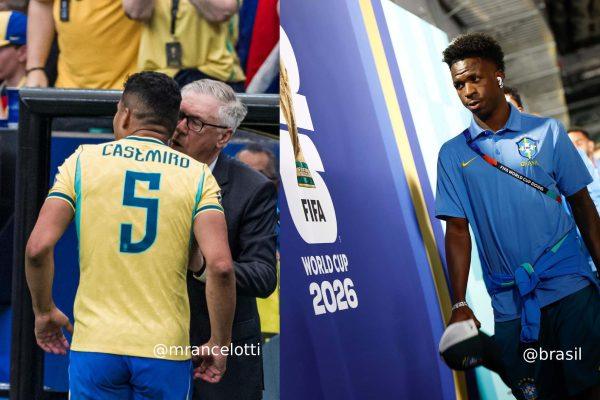
Brazil's 2026 World Cup campaign came to a shocking end in the round of 16, falling 2-1 to a disciplined Norway side. While Erling Haaland's leadership grabbed headlines, the real story unfolded in the 14th minute, when a penalty decision sparked a firestorm of debate about the role of data in football.
Matheus Cunha was brought down in the box by Kristoffer Ajer, and all eyes turned to Vinicius Jr., Brazil's leading scorer and emotional leader. But instead of the Real Madrid star, midfielder Bruno Guimarães stepped up. His driven shot was saved by Norwegian goalkeeper Ørjan Nyland, and Brazil never recovered.
The Algorithm That Overruled a Star
In the post-match press conference, Carlo Ancelotti defended his decision with a detailed explanation of the team's analytical framework. “We used a statistical ranking based on a full year of performance data for our players and the opposition,” he said. “The top penalty asset on paper was Raphinha. With the players on the pitch, the algorithm prioritized Neymar, then Igor Thiago, Guimarães, and Gabriel Martinelli.” Vinicius Jr. was not in the top tier.
The decision has reignited a long-standing debate in Latin American football: should cold data override the instincts of a talismanic player? For many Brazilian fans, the move felt like a betrayal of the jogo bonito spirit that values flair and intuition. Ancelotti, however, remains unapologetic, citing the numbers as his guide.
Data from the Brazilian Football Confederation (CBF) shows that while Vinicius has converted six of nine penalties for Real Madrid, his record with the national team is far weaker: he missed two of his three attempts, including a high-profile failure against Venezuela in 2024 qualifying. That history, combined with the algorithm, sealed his fate.
The loss also exposed deeper structural issues. Brazil finished the match with just 34% possession, their lowest in a World Cup since 1966. This marks their first round-of-16 exit since 1990, and all six of their last World Cup eliminations have come against UEFA opponents. The trend raises questions about whether Brazil's reliance on European tactical models is stifling its natural creativity.
For context, this isn't the first time data has clashed with star power in the tournament. Messi's selfless call to bench himself against Jordan showed a different approach, where experience and instinct won out. Meanwhile, Spain's plan to isolate Lamine Yamal highlights how analytics can be used to target opponents, not sideline your own stars.
As Brazil heads home, the debate over Ancelotti's methods will linger. For a nation that prides itself on footballing artistry, the algorithm's victory over Vinicius Jr. feels like a loss of identity. The question now is whether the Seleção can reconcile data with the soul of the game.