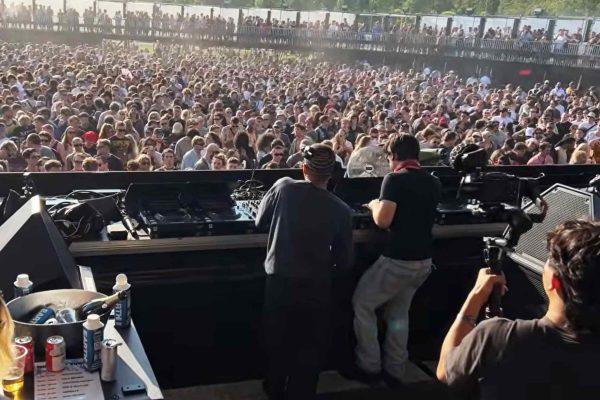
One of the most telling Latin music moments of the summer didn't happen at a Latin music festival. It happened at Dekmantel, the Amsterdam electronic music festival, where on July 31, São Paulo producer RHR went back-to-back with Skrillex at The Loop. For casual listeners, Skrillex is the obvious draw. But for anyone tracking where club music is heading, RHR is the more compelling story. His set showed something Brazilian music has been doing for years: entering global nightlife not by diluting its local identity, but by making that identity hit harder.
Baile funk is not American funk
The terminology can get confusing quickly. Brazilian funk—often called funk carioca or baile funk—grew out of the baile scenes of Rio de Janeiro, drawing from Miami bass and other electronic and Afro-diasporic influences before evolving into a vast ecosystem of its own. Today, “Brazilian funk” covers a range of related sounds rather than one fixed formula. What connects them is rhythm: percussion-forward, physical, repetitive music built for movement. RHR's work stretches that vocabulary further. Dekmantel describes him as part of a new wave of Brazilian artists breaking down what it calls the false divide between Brazil's established club circuits and the “favela-born force of baile funk.”
RHR—born Roniere Santos in Diadema, in the São Paulo metropolitan region—started DJing in 2010 and has explored techno, bass, electro, dancehall, and baile funk while keeping Brazilian percussion central. This is not a producer abandoning Brazil for European techno. It's a producer making Brazilian rhythmic language operate inside multiple club ecosystems.
Why the Skrillex connection matters
Skrillex has spent much of his post-dubstep career treating genre boundaries as suggestions. Pop, bass music, house, hip-hop, and experimental electronic music have all moved through his catalog and DJ sets. That makes RHR an unusually logical collaborator. Dekmantel had already noted that RHR had been working in the studio with Skrillex before their festival set. Then the pairing moved onto one of electronic music's most closely watched stages.
The symbolism is hard to miss. Years ago, “Latin crossover” often meant an artist from Latin America gaining access to the American or European mainstream by adapting to it. This works differently. Baile funk is not politely asking to enter the room. The room is adapting to baile funk.
If the beat sounds familiar, TikTok may have introduced you
Part of Brazilian funk's international advantage is that its rhythms work extraordinarily well in short-form video. Fast edits, football clips, dance videos, fashion content, gym videos, and meme formats all benefit from music with immediate rhythmic impact. That creates an unusual discovery pattern: listeners can become familiar with the texture of a Brazilian sound before they know anything about the artist, city, or scene behind it.
This is where cultural journalism has work to do. Calling every aggressive Brazilian club rhythm “phonk,” for example, can erase distinctions between Brazilian funk, internet-born phonk variants, and other electronic subgenres that overlap online. The algorithm flattens. Reporting should unflatten.
Brazil doesn't need outside validation, but outside attention is changing
It's also important not to frame baile funk as suddenly important because Skrillex played it. Brazil is one of the world's largest music markets. IFPI's 2026 Global Music Report ranked the country among the top recorded music markets, while Latin America as a whole grew 17.1% in 2025—faster than any other region. Brazilian audiences already sustain enormous homegrown stars and genres. The newer development is how often the rest of the world is running into Brazilian music on Brazilian terms.
Even Bad Bunny's relationship with Brazil illustrates how distinct that market can be. Ahead of his first performances there in 2026, AP reported that domestic artists accounted for roughly three quarters of Brazilian music consumption. In other words: Brazil is not a small scene waiting to be discovered. It is an enormous cultural market increasingly leaking outward.
RHR is the story precisely because he doesn't sound like a crossover strategy
There is no obvious “Latin pop” packaging around this moment. No Spanglish hook engineered for U.S. radio. No attempt to make Brazilian culture aesthetically legible by simplifying it. Instead, there is a DJ from greater São Paulo playing hard, percussion-heavy club music beside Skrillex in Amsterdam. That is a much more Gen Z model of globalization. Scenes connect directly. A SoundCloud track moves into a DJ set. A DJ set becomes a clip. A clip reaches another continent. A local rhythm becomes part of a producer's vocabulary thousands of miles from where it started.
This is the kind of moment that reminds us how Argentine producers like Bizarrap have also built global reach by staying rooted in local scenes. And as celebrations from São Paulo to México City show, the cultural currents flowing out of Latin America are as diverse as they are powerful. RHR's set at Dekmantel is just one more sign that the world is catching up to what Brazilian club culture has known for years: the beat is the message.