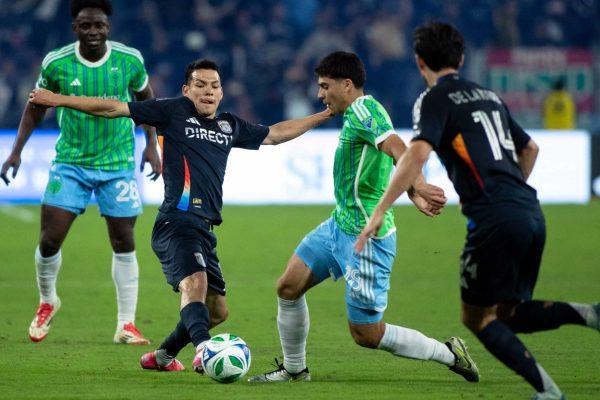
Hirving “Chucky” Lozano, the man who etched his name into Mexican football lore with that unforgettable goal against Germany in 2018, now finds himself in a peculiar limbo in Southern California. At 30, still in his physical prime, San Diego FC’s marquee acquisition has gone from franchise face to a luxury outcast, training alone in the afternoons while earning $6 million annually. The club’s front office, led by Tyler Heaps, has made it clear: Lozano is not part of their 2026 plans, despite the $12 million transfer fee and the hefty salary. This isn’t about injuries—it’s about a fractured relationship that seems beyond repair.
The October Incident That Changed Everything
The breaking point came in October 2025, during a heated locker room exchange after a tactical decision by head coach Mikey Varas. Sources close to the team describe the altercation as the catalyst for a series of behaviors that the sporting directors felt “did not reflect the culture the club seeks to project long term.” For San Diego FC, Lozano’s brilliance on the pitch no longer outweighs what they see as a misalignment with the team’s values. The club has chosen to pay his million-dollar salary just to keep him away from the main group, prioritizing harmony over individual talent.
This isn’t just a clash of egos; it’s a test of organizational identity. San Diego FC, an expansion side still building its reputation, is sending a clear message: no player is bigger than the project. President Mohamed Mansour has fully backed the technical staff, even if it means absorbing a financial hit. The club is willing to swallow the $6 million loss to set a precedent about authority and discipline—a move that echoes the growing professionalism in MLS, where culture is no longer negotiable.
A Transfer Market Deadlock
While San Diego actively seeks an exit for the winger, Lozano holds all the cards thanks to a no-trade clause in his contract. European clubs and Liga MX sides have shown interest, but the Mexican star has publicly stated his desire to stay in San Diego, where he enjoys the lifestyle and a guaranteed paycheck. This has created an administrative stalemate: the club doesn’t want him on the field, but the player is in no rush to leave. Management is even considering contract termination if no solution emerges before the March deadline.
This standoff has serious implications for Mexico’s national team. Javier “El Vasco” Aguirre has been unequivocal: he needs players with competitive rhythm for the 2026 World Cup, which will be hosted across North America. Lozano was left out of recent squads, including the February friendly against Iceland, and the message is clear—his historical status won’t guarantee a spot without playing time. The lack of match fitness casts doubt on whether “Chucky” can represent his country in the most important tournament of his career, a sacrifice he seems willing to make rather than yield in his dispute with San Diego.
Meanwhile, San Diego FC has proven it can thrive without its biggest star. Convincing wins like the 5-0 thrashing of Montreal in the season opener and a global victory over Pumas in the Concacaf Champions Cup have validated the club’s stance. Players like Amahl Pellegrino and young Bryan Zamblé have stepped up, scoring goals that recall Lozano’s best form and symbolizing a generational shift the club has embraced. This sporting stability relieves pressure on ownership to reintegrate the Mexican, reinforcing their decision to prioritize group cohesion.
From a financial perspective, the situation is a challenge, but Mansour has stood firm. The organization is willing to absorb the economic loss to set a precedent about the coach’s authority and the sporting direction. It’s not just about money—it’s about identity. The club is looking for a solution that benefits both parties in the long run, but not at the cost of compromising the playing style and internal discipline they consider pillars for success in MLS.
The question lingering for fans is how long Lozano can endure this before his career is irreparably affected. Training alone while the world prepares for the World Cup is a calculated risk that could end in premature retirement from the elite or a forced last-minute transfer. Chucky’s saga in San Diego is a reminder that in modern American soccer, astronomical salaries no longer buy immunity from organizational culture policies. The outcome of this conflict will define not only Lozano’s future but also San Diego FC’s seriousness as an emerging powerhouse in the league.
For a deeper look at how Latino athletes navigate career crossroads, check out our piece on Víctor Muñoz: The Transfer Battle That Could Define Barcelona and Real Madrid's Summer. And for more on the business of sports, see The 5 Greatest Latino First Basemen Who Redefined MLB History.